
Common Odoo Implementation Mistakes—and How Experienced Partners Prevent Them
February 17, 2026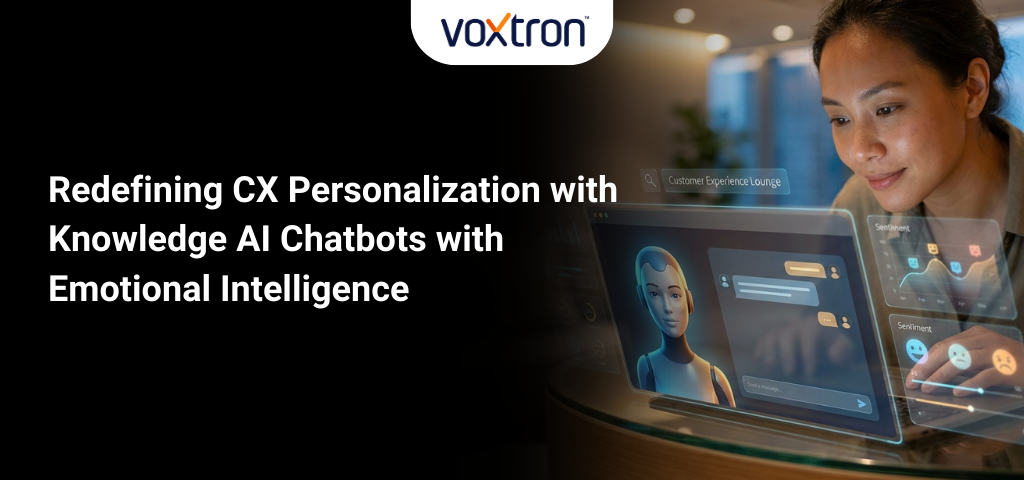
Redefine CX Personalization with Knowledge AI Chatbots with Emotional Intelligence
For years, enterprises invested in chatbots to reduce agent workload and deflect repetitive queries. However, that phase is over. Modern AI chatbots are no longer evaluated on whether they work. Instead, it is based on how well they deliver under real operational pressure.
Today’s customers they expect more than instant replies. They expect:
- Continuity across channels
- Accurate, up-to-date information
- Empathy during moments of friction
- Proactive engagement that feels helpful, not intrusive
Such a shift in expectations forces business leaders to rethink their CX technology stacks.
This is where Knowledge AI chatbots with emotional intelligence stand out. These powerful chatbot solutions do not operate in isolation, but as part of a governed, human-in-the-loop engagement ecosystem.
Voxtron’s Engage360 is the perfect example of such a Knowledge-AI powered chatbot.
Why Traditional AI Chatbots Are Failing Modern CX Teams
Despite advances in generative AI, many chatbot deployments still suffer from the following foundational flaws:
- Static knowledge models that fall out of sync with business updates
AI responses based on outdated information deliver incorrect answers when policies, pricing, or processes change, with CX leaders reporting persistent issues despite AI adoption.
- Black-box AI decisions with limited oversight
The system makes decisions without transparency, leaving teams unable to understand, audit, or correct AI behavior in real time.
- Delayed escalations, triggered only after customer frustration peaks
Human intervention happens only after the customer experience has already deteriorated, increasing churn and recovery costs.
- Disconnected CX tools for bots, agents, supervisors, and campaigns
Customer context is fragmented across multiple platforms, causing inconsistent interactions and operational inefficiency.
Additionally, enterprises face tool sprawl with separate systems inflating costs. AI initiatives may fail due to poor governance and integration gaps. Inconsistent WhatsApp or Teams interactions can erode trust in high-stakes sectors like finance. These shortcomings create operational risk and inconsistency for the business.
Meanwhile, for customers, it results in broken experiences that feel automated rather than intelligent. Hence, the pressing requirement is for better orchestration of intelligence across humans, AI, and knowledge.
What Defines a Knowledge AI Chatbot with Emotional Intelligence?
Knowledge AI chatbots go beyond intent detection and scripted responses. They are designed to:
- Retrieve information from live, authoritative knowledge sources using RAG (Retrieval-Augmented Generation)
- Understand context, including customer history, channel, and interaction patterns
- Detect sentiment and emotional signals, not just keywords
- Decide when to respond, escalate, assist, or intervene
Emotional intelligence in CX is based on situational awareness. It means knowing when automation is sufficient and when human judgment is essential.
Engage360 operationalizes this concept through a three-layer CX intelligence model.
Engage360’s Three-Level Model for Intelligent Customer Engagement
1. AI-Powered Chatbots with Live Knowledge Access
At the foundation, Engage360 functions as a knowledge AI chatbot capable of handling customer interactions across WhatsApp, webchat, email, mobile apps, MS Teams, and social channels.
Unlike traditional bots trained on static datasets, Engage360:
- Pulls information from live knowledge bases
- Reflects real-time updates to pricing, policies, SLAs, and inventory
- Uses intent classification and sentiment analysis to tailor responses
- Provides consistent answers across all touchpoints
This significantly reduces misinformation, which is one of the biggest risks associated with generative AI in customer experience.
2. AI Agent Assist with Real-Time Supervisor Barge-In
When a conversation requires human expertise, Engage360 transitions seamlessly from bot to agent, without losing context.
Thus, agents receive:
- AI-generated response suggestions
- Knowledge citations and summaries
- Customer history and interaction timelines
- Sentiment indicators that highlight emotional risk
Most CX platforms escalate after failure. However, what sets Engage360 apart is its live supervisor barge-in capability.
Supervisors can:
- Monitor conversations in real time
- Step in during critical moments
- Guide agents before an issue escalates
- Maintain quality, compliance, and customer trust
Thus, Engage360 allows supervisors to intervene during uncertainty, preserving both customer relationships and brand reputation.
3. Proactive Engagement Through Context-Aware Campaigns
In most CX stacks, outbound campaigns are disconnected from support interactions. However, Engage360 removes this divide.
Its campaign and marketing module enables:
- Context-driven upsell and cross-sell opportunities
- Event-based surveys and feedback loops
- Lifecycle-driven reminders and notifications
- Journey-aware customer nudges
From the customer’s perspective, campaigns feel relevant and because they are informed by real interaction data. This is especially critical as customers become increasingly resistant to generic outreach.
Unified CX Orchestration: Solving the Tool Sprawl Problem
One of the most pressing challenges for enterprises is CX tool sprawl. Separate systems for bots, CRM, helpdesk, campaigns, analytics, and agent assist lead to fragmented data and rising costs.
However, Engage360 fixes this problem. It consolidates:
- AI chatbots
- Unified agent interface
- Helpdesk and ticketing
- Mini CRM and lead management
- Surveys, campaigns, and dashboards
Its journey orchestration engine connects AI Agents, RAG bots, workflows, and backend systems such as CRM, ERP, and HRMS. Thus, Engage360 successfully creates a single operational layer for customer engagement.
For leaders, this translates into:
- Easier governance
- Lower integration overhead
- Reduced total cost of ownership
Why Should Your Business Prioritize Knowledge AI?
Recent enterprise CX research highlights several converging trends:
- AI governance and human oversight are now mandatory
- Real-time knowledge accuracy outweighs generic LLM fluency
- Emotional intelligence is emerging as a measurable CX KPI
- Organizations are consolidating CX platforms to improve control
Engage360 aligns directly with these priorities by combining technical sophistication with operational transparency.
Business Impact: From Efficiency to Strategic Advantage
Organizations adopting Knowledge AI chatbots like Engage360 with emotional intelligence report measurable outcomes:
- Faster resolution through contextual continuity
- Higher first-contact resolution rates
- Reduced agent burnout via AI-assisted workflows
- Improved customer retention through proactive engagement
- Better compliance and quality control through supervisor intervention
More importantly, they gain future readiness. This CX architecture is designed to evolve as AI regulations, customer expectations, and enterprise needs change.
Conclusion: The Next Era of CX Is Intelligent Orchestration
The future of customer experience is not about replacing humans with AI. Instead, it is about designing systems where AI, humans, and knowledge continuously reinforce each other.
Knowledge AI chatbots with emotional intelligence represent this shift—from automation to orchestration, from scripts to situational awareness, and from fragmented tools to unified engagement ecosystems.
With Engage360, Voxtron delivers a platform that doesn’t just respond to customers—but understands them, supports teams, and scales intelligence across the entire organization. Ready to transform your CX? Schedule a free Engage360 demo today to unify channels, govern AI, and retain customers. Contact Voxtron now.