
Redefine CX Personalization with Knowledge AI Chatbots with Emotional Intelligence
February 27, 2026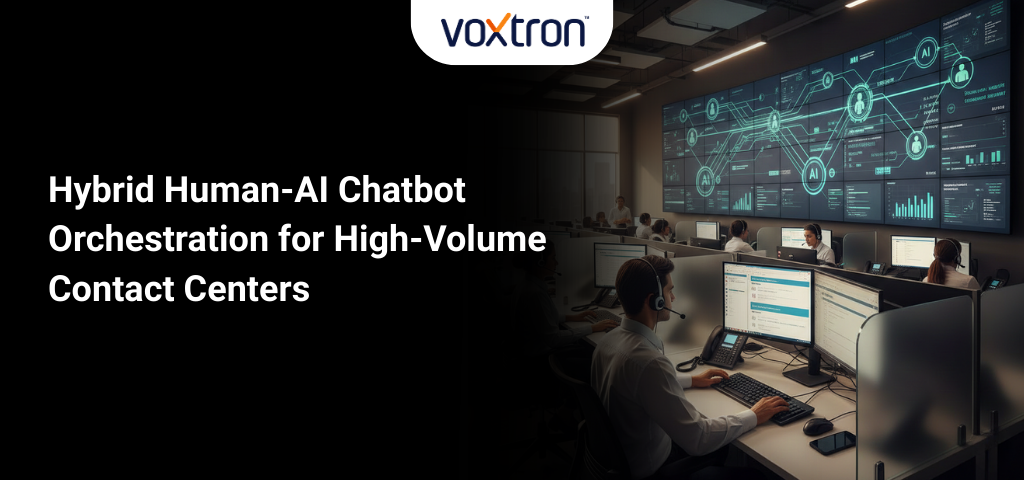
Hybrid Human-AI Chatbot Orchestration for High-Volume Contact Centers
Most high-volume contact centers operate efficiently at baseline demand. However, the strain appears when volumes spike. Additionally, challenges appear when the business adds new channels or layers AI onto existing workflows without clarity on how context moves across systems. Thus, handoffs lose continuity, conversations reset, and rework quietly accumulates.
Consequently, agents end up spending more time reconstructing intent than resolving issues. This erodes service quality and agent morale.
Many legacy CCaaS platforms and traditional helpdesks unintentionally worsen these problems.
This is where hybrid human–AI chatbot orchestration emerges as a practical solution. By coordinating AI and human agents through a unified orchestration layer, organizations can meaningfully reduce operating costs while improving service consistency and customer satisfaction.
What are the Core Challenges in High-Volume Operations?
One of the most persistent issues in contact centers processing large-scale interactions is integration silos. Vendor-locked tools across chat, voice, CRM, and ticketing platforms fail to share context in real time. As a result, conversations frequently reset during transfers. This typically inflates transfer rates by over 30% in many environments and slows down handoffs.
Furthermore, scalability is a pressure point. In distributed and multi-tenant environments, older platforms struggle to scale securely during demand spikes. Compliance, monitoring, and performance consistency often weaken when remote teams are managing unpredictable volumes.
Agent overload further compounds the problem. Frontline agents routinely spend hours every day searching for answers across knowledge bases and internal systems. A large majority indicates that instant access to accurate, contextual knowledge would significantly improve both productivity and job satisfaction.
Finally, data fragmentation directly affects customer outcomes. When CRM data, interaction history, and channel context remain disconnected, first-contact resolution typically declines, driving repeat contacts and higher operational costs.
Introducing Orchestration: Conducting the Customer Journey
In practical terms, orchestration is the logic layer that decides how, when, and by whom each customer interaction should be handled. It acts as the central conductor of modern contact center operations. It includes everything from the first touchpoint to final resolution.
Using real-time intent detection, sentiment analysis, and complexity scoring, orchestration proactively directs interactions to the most appropriate resolution path. Here, routine, low-complexity queries are resolved autonomously. Meanwhile, emotionally sensitive or complex issues are escalated early.
Customer history, transcripts, and interaction context remain intact as conversations move across channels. This continuity reduces repetition and improves both agent effectiveness and customer confidence.
Thus, for SMEs transitioning from rigid helpdesks, orchestration delivers immediate scalability. With AI handling an estimated 60–80% of routine interactions, it allows human agents to focus on higher-value conversations without proportional increases in staffing.
Although orchestration originated in enterprise environments, cloud-native delivery now makes it practical and accessible for growing SMEs.
Mastering AI-Agent Handoff in Hybrid Setups
Effective AI–agent handoff is integral for successful orchestration. When executed correctly, handoffs strengthen the customer journey rather than disrupt it.
This is how it works:
- AI chatbots first evaluate incoming queries, assessing intent, sentiment, and complexity.
- When escalation becomes necessary, the system swiftly transfers enriched context to human agents. This includes full transcripts, customer history, and suggested responses.
Without orchestration, handoffs commonly fail. Agents repeat questions, handle times increase, and customer frustration grows. Orchestrated environments counter this through dynamic decisioning that predicts escalation needs early.
Furthermore, real-time sentiment indicators guide agents during live conversations, while shared knowledge repositories ensure consistency across teams.
Contact centers that adopt orchestrated handoffs report faster routing and measurable gains in customer satisfaction, reinforcing the effectiveness of hybrid AI–human models.
Knowledge AI Chatbots for Powering Precision Handoffs
Knowledge AI chatbots such as Engage 360 enhance orchestration by providing accurate, enterprise-specific intelligence at every stage of the customer interaction.
These chatbots are superior to generic NLP bots. Here, Knowledge AI indexes curated organizational content such as FAQs, policies, product documentation, and historical interactions for precise retrieval.
Engage 360 also supports multiple operational layers: self-service deflection, enriched AI–agent handoffs, and supervisor-level analytics. During live transfers, it pre-populates agent desktops with relevant summaries and recommended knowledge. Thus, it significantly reduces search time.
Additionally, the system continuously learns from real interactions. Thus, knowledge remains current and aligned with evolving customer language. Agents equipped with rapid, contextual knowledge access consistently perform better across resolution speed, quality scores, and confidence.
Complete Orchestration Solution with VoxVantage
Understanding orchestration is only useful if it can be implemented without adding complexity.
Many platforms claim to support hybrid AI and human workflows, but in practice they rely on bolt-on integrations and custom logic that recreate the very silos that orchestration is meant to eliminate.
A complete orchestration solution must therefore be native, scalable, and designed to coordinate people, AI, and systems as a single operating layer.
Voxvantage CCaaS addresses high-volume operational challenges through built-in hybrid orchestration. Open APIs break down system silos while auto-scaling infrastructure absorbs peak surges without performance degradation. Furthermore, real-time sentiment routing improves customer outcomes, while compliance and monitoring capabilities support secure, multi-tenant operations.
For organizations migrating from legacy setups, Voxvantage offers low-code workflows, unified analytics, and AI-driven coaching. These capabilities can reduce agent turnover and accelerate integrations. Furthermore, remote agents benefit from instant knowledge access and dynamic scripting, improving FCR without extensive training.
An Easy Implementation Roadmap for SMEs
For many SMEs, the biggest hesitation around orchestration is complexity. Large-scale platform changes are often associated with long timelines, operational risk, and heavy dependency on IT teams.
Orchestration, however, can be designed to layer intelligently over existing workflows.
Transitioning to orchestration can be achieved without major disruption through:
- Audit system silos and handoff friction points
- Pilot VoxVantage orchestration in a priority queue
- Deploy Engage 360 for targeted knowledge enrichment
- Roll out AI coaching with performance tracking
Since Voxvantage is cloud-native, organizations can go live in as little as four weeks, with early operational gains visible soon after deployment. It is often without interrupting day-to-day service delivery.
Conclusion
Customer experience is a primary competitive differentiator for forward-thinking organizations. Hybrid human–AI chatbot orchestration through Voxvantage and Engage 360 transforms high-volume complexity into scalable efficiency by improving handoffs, empowering agents, and delivering measurable business outcomes.
For CX and operations leaders ready to move beyond legacy constraints, Voxvantage provides a clear, future-ready upgrade path. To explore how this can transform your business to begin orchestrating sustainable growth, contact our team today.