
Odoo Implementation Checklist: Are You Ready to Go Live?
February 17, 2026
Redefine CX Personalization with Knowledge AI Chatbots with Emotional Intelligence
February 27, 2026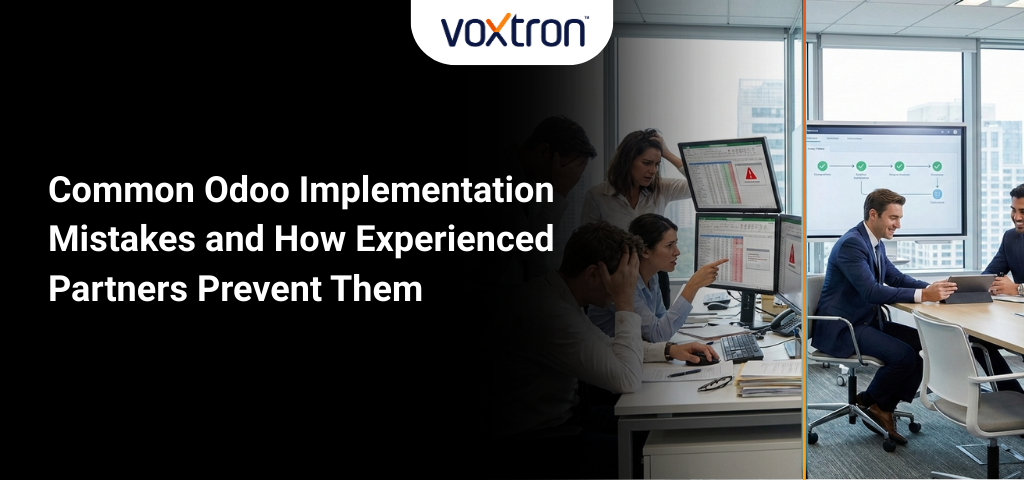
Common Odoo Implementation Mistakes—and How Experienced Partners Prevent Them
Industry studies indicate that 55–75% of ERP projects derail due to avoidable mistakes. This often results in cost overruns of up to 189% and significant operational disruption for growing SMEs.
Many businesses experience delays in data migration by several months, leading to significant expenses in post–go-live corrective fixes. However, the software rarely causes such outcomes. This typically occurs because of decisions made during implementation, often early on.
Experienced Odoo partners see these patterns repeatedly across industries and business sizes. The difference in outcomes lies in how they challenge assumptions, identify risks, and how closely implementations adhere to Odoo’s architectural and functional standards. Whereas DIY or under-guided projects replicate legacy inefficiencies, seasoned partners focus on alignment, validation, and scalability
This approach ensures that Odoo evolves with the business rather than constrain it.
Let us look at the most common Odoo implementation mistakes that businesses face during Odoo ERP implementation—and how they can be effectively fixed.
Mistake 1: Ignoring Odoo’s Built-In Best Practices
Odoo is designed with embedded best practices refined across thousands of implementations.
Yet many SME leaders may assume that their internal processes are inherently superior. This often results in rigid customisations that complicate upgrades and inflate long-term maintenance costs.
However, legacy operational chaos gets directly translated into custom code, and leads to upgrade-related overruns.
An experienced Odoo partner approaches this differently. Rather than unquestioningly implementing existing workflows, they evaluate whether those processes truly add business value or simply reflect habit.
Through early validation and realistic scenario testing, partners ensure that Odoo’s standard frameworks are leveraged wherever possible. It allows the system to introduce discipline instead of reinforcing inefficiency. This approach not only reduces future upgrade friction but also shortens implementation timelines by eliminating unnecessary custom work.
Mistake 2: Scope Creep from Undefined Requirements
The requirement definition and analysis phase is critical to the success of an Odoo implementation.
When the business requests features reactively, incorporating it impacts compliance, reporting, or performance. Poorly defined objectives invite continuous additions mid-project.
For instance, let us assume a logistics firm introduces multi-entity requirements late in implementation. There is a high likelihood of it failing audit readiness. This reflects a broader trend where scope creep contributes to ERP failure.
Seasoned Odoo partners counter this by grounding implementations in structured discovery, not assumptions. They translate business goals into Odoo-aligned requirements early. Additionally, they test feasibility before commitment, and sequence functionality in line with operational maturity.
This disciplined approach prevents uncontrolled expansion, ensures core operations stabilise first, and typically avoids 25–30% timeline overruns seen in loosely defined projects.
Mistake 3: Data Migration Without Validation
ERP systems amplify data quality regardless of whether they are good or bad.
Legacy systems often contain duplicates, outdated masters, and inconsistent records, especially when maintained through spreadsheets. Migrating this data without validation compromises inventory accuracy, financial reporting, and decision-making. Industry analysis attributes up to 70% of ERP overruns to poorly handled data migration.
However, experienced Odoo partners treat data migration as a transformation exercise. They ensure cleansing, standardising, and validating data through simulated migrations well before go-live. This approach helps to identify structural issues early. This ensures that the ERP starts with reliable data, supporting accurate reporting and stable operations as transaction volumes grow.
Mistake 4: Weak Change Management and Training
Even well-configured systems fail when due to users lacking preparedness. Without structured training, teams revert to familiar tools like Excel. When this happens, they bypass ERP workflows altogether.
One mistake many SMEs make is to have only one-time training sessions. This is usually insufficient for lasting adoption, and studies show that poor change management can reduce effective ERP usage by up to 70%.
An experienced Odoo partner recognises that adoption is an ongoing process. They prioritize driving the user adoption and change management processes. By embedding learning into day-to-day workflows and monitoring adoption after go-live, partners help organisations move from resistance to ownership. This helps the business ensure that the Odoo system becomes integral for all operations rather than optional.
Mistake 5: Overloading Modules Too Early
Odoo’s modularity is a strength. However, installing every available app from the outset can overwhelm users. Overextended CRM and operational modules can slow sales processes by up to 40%, aligning with data that links over-configuration to 73% of ERP failures.
Experienced partners resist the temptation to switch everything on. Instead, they align module activation with business readiness. A good Odoo partner will introduce only essential functionality initially. However, as teams mature and processes stabilise, they phase in additional modules. This preserves performance, usability, and long-term scalability.
Mistake 6: Ignoring Post–Go-Live Scalability
Many implementations are designed only for current operations, not future growth. Custom-heavy designs and untested performance assumptions lead to bottlenecks as transaction volumes increase.
Within the first year, reporting delays, upgrade blocks, and operational slowdowns of 25–30% are common.
Experienced Odoo partners anticipate growth. They design configurations that remain upgrade-safe, test systems under higher load scenarios, and periodically review performance post go-live. This forward-looking approach ensures that Odoo continues to support expansion rather than becoming a constraint.
DIY vs. Partner-Led Implementations: The Structural Difference
| Aspect | DIY / Solo Implementation | Experienced Odoo Partner |
| Failure Risk | 55–75% | Significantly reduced through validation |
| Cost Control | Overruns up to 189% | Predictable, governed delivery |
| User Adoption | Reversion to spreadsheets | Structured, sustained usage |
| Scalability | Post–go-live surprises | Growth-aligned system design |
Conclusion
Most Odoo implementation mistakes are not caused by limitations in the platform but by decisions made during planning, configuration, and adoption. Ignoring built-in best practices, allowing scope to drift, migrating poor-quality data, underestimating change management, overloading modules, or failing to plan for scale all create risks that compound as the business grows.
When implemented with foresight and discipline, Odoo becomes a stable foundation for long-term growth. This is where experienced implementation partners such as Voxtron play a critical role. We bring structured governance, practical validation, and scalability-focused design that help organisations avoid common pitfalls and sustain value well beyond go-live. Contact our team to learn more about how we can help your organization with a successful and efficiently planned Odoo ERP implementation.