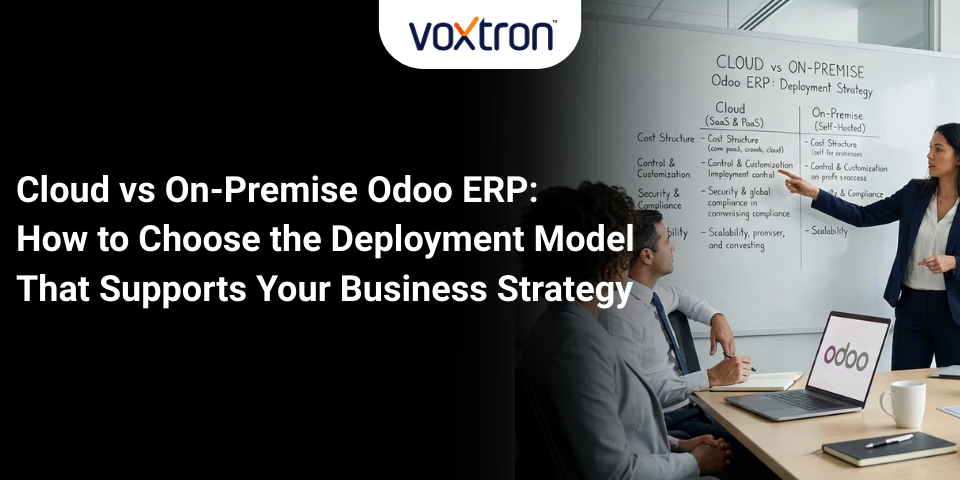

Cloud vs On-Premise Odoo ERP: How to Choose the Deployment Model That Supports Your Business Strategy
January 23, 2026
Effortless Lead Generation: How Engage 360 Automates Your Sales Pipeline
January 23, 2026
Top Customizations SMEs Ask for in Odoo and Why They Matter
As SMEs transition from basic ERPs to industry standards like Odoo, they usually hit the same challenges. Typically, these arise out of operating multiple branches, more audits, more people, and too many workarounds in Excel or WhatsApp.
Like all ERP solutions, Odoo may not exactly match the way your sales, finance, operations, and HR teams actually work day to day. However, Odoo allows for extensive customization to overcome these challenges. It is the right approach to align Odoo with your real operational structures, regulations, and growth plans.
Why Customization Becomes Inevitable as SMEs Scale
ERP challenges surface gradually as the business grows in complexity, with more stakeholders, more controls, and a greater need for visibility.
For leadership, it helps to look at ERP customization as three separate layers:
- Configuration: settings, roles, taxes, approval rules, document templates.
- Low‑code tweaks: custom fields, views, dashboards, simple automations.
- Custom development: new modules, complex integrations, deep logic changes.
The following five patterns will help you see what you actually need.
Customization pattern 1: Fixing past chaos
The first category of custom work is about cleaning up loose ends from your past operations.
For example, an IT services firm might use scripts to migrate years of projects, invoices, and timesheets from multiple tools into Odoo. This allows leadership to finally see margins by client, project, and country.
Apart from data migration, it is also an opportunity to standardize masters, remove duplicates, and define how “truth” will look in your new system.
Through this customization, SMEs can unlock better reporting, faster audits, and smoother scaling.
Customization pattern 2: Standardizing how people actually work
Growing SMEs quickly discover they need:
- Multi‑step approvals for purchases, expenses, discounts, and credit limits.
- Clear rules for who can approve what, and what happens when amounts cross certain thresholds.
- HR workflows for leave, overtime, and payroll inputs that reflect real authority, not the org chart on paper.
When leadership actively participates in designing these flows, Odoo becomes a governance tool, not just a transaction system.
Customization pattern 3: Reflecting your market and regulations
For SMEs in the Middle East, India, and other parts of the world, some customizations are non‑negotiable because of local rules and expectations. Examples include:
- GST, TDS, and e‑invoicing specifics in India, or ZATCA/e‑invoicing in KSA.
- Arabic–English bilingual invoices, quotations, and receipts.
- Country‑specific payroll, leave rules, end‑of‑service benefits, and statutory reports.
These remove hidden compliance risk, reduce disputes with tax authorities or auditors, and eliminate the need for side‑spreadsheets that increase the risk of error and fraud.
Customization pattern 4: Orchestrating channels and locations
When the business scales to more branches, channels, or delivery partners, your Odoo customization profile needs to change.
A restaurant group, for example, might need a POS setup that supports multiple locations, menus, and a single unified platform for different delivery partner logins. Here, the goal is to have one coherent operational and financial view across outlets, online orders, and aggregators.
Similar logic applies to trading companies that integrate e‑commerce, logistics partners, and warehouses.
Customization pattern 5: Leadership visibility and decision speed
Almost every serious SME Odoo rollout ends up with requests like:
- A CEO dashboard showing sales, cash, collections, and project health in one view.
- Branch or country‑wise performance tracking.
- Customer aging and risk views that match how the business actually thinks about credit and exposure.
These custom reports and dashboards are where your real ROI hides. Hence, Odoo customizations allow the leadership team to move away from Excel and other supporting tools.
The need to look beyond Technical Capability when choosing an Odoo Partner
Most Odoo partners can:
- Add custom fields and views.
- Modify basic workflows and validations.
- Create simple reports and document templates.
- Customize invoice or quotation layouts.
- Do straightforward integrations (email, SMS, basic WhatsApp, simple APIs).
Many partners are brilliant at code but weak on business context. So, they may:
- Replicate bad manual processes inside Odoo instead of challenging them.
- Write custom code where smart configuration would do the job.
- Miss out on edge cases that are obvious to someone from your industry.
- Break or ignore future upgrade paths.
- Create dependency, where only they can “decode” what was done.
This gap in business understanding appears in the form of rework, user frustration, and upgrade pain.
A partner with genuine experience in your type of business brings questions and patterns you cannot fully capture in a requirement sheet.
Example: SMEs and approvals
A generic partner might implement three‑level approvals everywhere because more controls are safer. Meanwhile, a seasoned SME partner knows that owners will override some approvals. They also realise that speed often matters more than hierarchy in fast‑moving deals. Furthermore, approval fatigue kills adoption and pushes people back to older systems.
So, they design:
- Threshold‑based approvals (amounts, risk, customer category).
- Exception paths and emergency overrides with proper audit trails.
- Fewer, smarter approvals that protect the business without paralysing it.
What to look for in an Odoo business partner
Good Odoo customization is a combination of three skills: Odoo Technical knowledge, business process understanding, and change management.
You should be very cautious about choosing your Odoo partner if:
- Business processes are informal but business‑critical (discounts, purchasing, project work).
- There are stringent compliance requirements (GST, payroll, local labour law, industry norms, e‑invoicing).
- You expect to grow in branches, geographies, or product lines.
- The team prefers to minimize custom code and keep upgrades manageable.
- You want Odoo to discipline and standardize the business, not mirror the current chaos.
The right partner does not say “yes” to every customization request, but
- Challenges you when you are trying to drag old habits into a new system.
- Prioritizes configuration and upgrade‑safe patterns.
- Designs Odoo so your next phase of growth is easier, not harder.
For the leadership team evaluating Odoo, the real decision is not just which modules to adopt or what to customize. Instead, it is about who you can trust to turn those customization decisions into a scalable backbone for the business.
At Voxtron, we work with SMEs to ensure Odoo customizations strengthen governance and visibility without creating unnecessary complexity. Our focus is on business-led design that helps Odoo evolve into a reliable backbone as the organization scales. To learn more about how SMEs have approached Odoo customization, please contact our team.