
Odoo for Non-Tech Founders: How to make your ERP Simple and Scalable
December 24, 2025
Top Customizations SMEs Ask for in Odoo and Why They Matter
January 23, 2026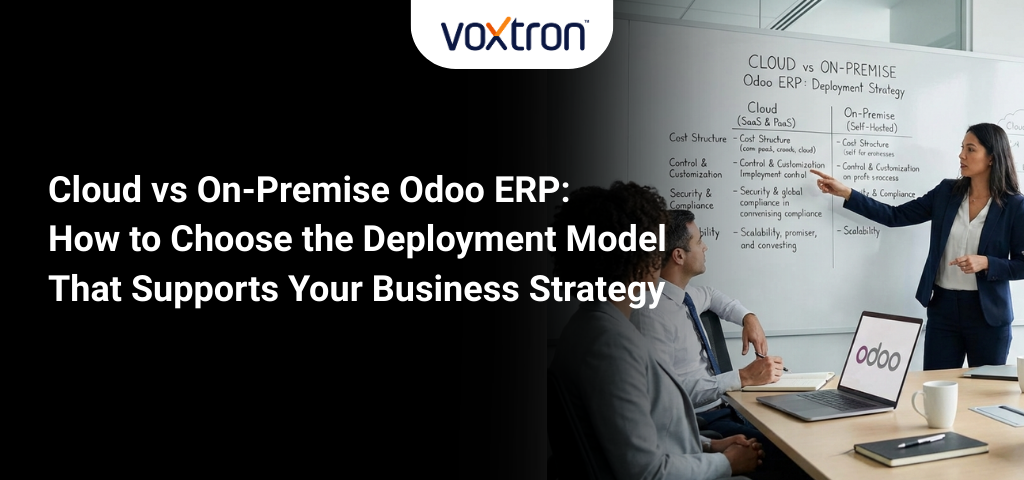
Cloud vs On-Premise Odoo ERP: How to Choose the Deployment Model That Supports Your Business Strategy
Whether to deploy Odoo in the cloud or on your own servers is one of the most strategic technology decisions for an SME. This choice affects how quickly you can expand, how smoothly your operations run, how predictable your costs remain, how protected your data is, and how ready you are for future innovation.
Many organisations begin this conversation by comparing subscription fees with server expenses. But your decision should actually be based on what type of growth you are aiming for, and what level of control your business needs.
Odoo’s flexible deployment models make it suitable for a wide range of operating styles. However, understanding the strengths and trade-offs of each model is key to making the right choice.
Understanding Cloud ERP vs On-Premise ERP
Odoo can be deployed in two ways: cloud or on-premise.
Both deliver the same ERP capabilities. However, the difference lies in who manages the infrastructure.
Cloud Deployment
The Odoo cloud model includes Odoo Online and Odoo.sh. It handles hosting, updates, backups, and uptime for you. With this model, your teams simply log in and use the system, without worrying about servers or security maintenance.
On-Premise Deployment
This involves installing Odoo on your own servers or private hosting environment. Your IT team manages everything (hardware, networks, backups, and upgrades). It offers full control but requires stronger technical capacity.
In essence, cloud prioritises convenience and speed, while on-premise prioritises control and customisation.
Comparing Total Cost of Ownership (TCO) for both models
Instead of comparing subscription fees with hardware costs, a more accurate approach is evaluating the total cost of ownership over several years.
Cloud Odoo
Cloud deployments tend to reduce long-term costs because:
- Upfront investment is low.
- Monthly or yearly subscription fees are predictable.
- No spending is required for servers or storage.
- Implementation is faster.
- Automatic updates reduce IT workload.
On-Premise Odoo
This model can be cost-effective only when supported by a capable internal IT team. It brings:
- Higher upfront investment for servers and licences.
- Ongoing labour costs for IT management.
- Responsibility for all upgrades, patches, and server issues.
- Potentially higher cost if environments change frequently.
The financial question is not only “How much?” but “Which model reduces risk while supporting sustainable growth?”
Key Factors Leaders Should Evaluate
A clear evaluation framework helps ensure your deployment model supports your long-term business direction.
1. Growth and Expansion
Cloud suits organisations planning new outlets, teams, or locations. It allows rapid deployment with minimal setup.
Meanwhile, on-premise models suit operations that expect steady, low-change environments.
2. Internal Skills and Capacity
Cloud reduces reliance on specialised IT talent and guarantees a consistent environment.
On-premise ERP requires a team capable of managing security, updates, backups, and server health.
3. Security and Business Continuity
Both models can be secure, but the responsibility differs.
Cloud environments offer provider-managed monitoring, intrusion protection, redundancy, and automatic patching. These reduce risk exposure and human error.
However, on-premise environments require disciplined internal processes. Your team must manage firewalls, backups, encryption, and recovery planning. This model is suited to businesses that must maintain full internal control.
4. Financial Planning
Cloud aligns with predictable operating expenses.
On-premise aligns with capital expenses and suits organisations comfortable with upfront investments.
5. Customisation Needs
Cloud supports many custom modules, as long as development follows structured guidelines.
- Odoo Online focuses mainly on configuration.
- On-premise supports deeper customisation but increases the complexity of future upgrades.
The level of customisation you need should influence your deployment choice.
Security, Compliance, and Data Protection
Security directly affects business continuity and trust. Cloud and on-premise both support secure operations, but their approaches differ.
Cloud deployments benefit from centralised monitoring, regular patching, and built-in redundancy. Here, providers ensure consistent protection, making daily security a minimal burden on internal teams.
On-premise deployments give you full authority over data and infrastructure. However, this also means full responsibility. Strong internal governance is required to maintain security quality, disaster recovery, and audit readiness.
The ideal choice depends on whether your priority is ease and reliability or total internal ownership.
Agility, Upgrades, and Future Readiness
A major difference between deployment models is how easily you can adopt new Odoo features.
Cloud in most cases receives updates automatically, allowing teams to access performance improvements, new tools, and emerging capabilities quickly. This supports organisations that value agility and continuous improvement.
However, on-premise upgrades must be planned, tested, and scheduled. Furthermore, customisations may slow the process. This approach is ideal for businesses that prefer predictable, controlled change cycles over rapid evolution.
A Practical Decision-Making Checklist for Cloud Vs On-Premise ERP
The following checklist helps leadership teams align on the most suitable deployment model.
- Start by reviewing your growth plans. Are you expanding rapidly or operating in a stable environment? Do you need multi-site access without building large IT infrastructure?
- Next, look at your budget style. Do you prefer predictable monthly costs, or a one-time investment followed by internal maintenance?
- Evaluate your risk and compliance stance. Do you need full internal control of data, or is provider-managed compliance sufficient for your needs?
- Assess internal capability. Do you have the talent to manage servers, updates, and security? Can you maintain this consistently?
- Finally, consider customisation depth. How much tailoring do your processes require? Will extensive custom development slow down future upgrades?
These questions create clarity on what your organisation values most.
If your answers centre on flexibility, faster rollout, predictable costs, and reduced technical burden, cloud deployment is likely the stronger fit. It ensures reliable performance without the complexity of internal infrastructure management.
Meanwhile, if your answers highlight strict compliance requirements, deep customisation needs, or strong in-house technical capability, on-premise may be the more suitable approach. This model grants full control over data, upgrades, and architecture.
Conclusion: Choose the Deployment Model That Supports Your Vision
There is no universally better ERP deployment model. The right choice is the one that aligns with your strategy, operating style, internal capability, and appetite for control.
Cloud offers speed, flexibility, and predictable costs. On-premise offers autonomy, deep customisation, and full ownership.
A deliberate, well-informed decision today ensures that your Odoo environment grows with your business. To make an informed decision regarding your ERP deployment, get in touch with our Odoo experts at Voxtron.