On-Premise vs Cloud Contact Centre in the UAE: The Compliance Question Most Vendors Won’t Answer
June 18, 2026
WhatsApp Business API for UAE Enterprises: What Engage360 Does That a Standard Provider Can’t
June 18, 2026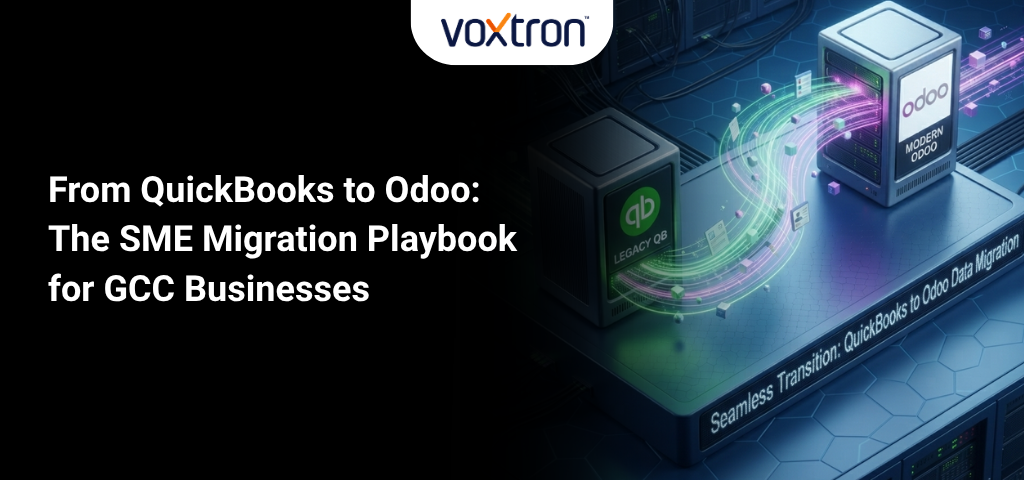
From QuickBooks to Odoo: The SME Migration Playbook for GCC Businesses
QuickBooks did its job. For an SME in its first five years, it kept the books straight, handled VAT once that arrived, produced clean financial reports, and let the founder sleep at night. But somewhere between hiring the tenth employee and opening the second warehouse, the cracks started showing.
Sales sit in one tool. Inventory in another. Procurement runs out of spreadsheets. Payroll has its own login. The accountant exports to Excel, cleans the data manually, and re-uploads it because nothing speaks to QuickBooks natively. The numbers eventually balance, but the team spends more time reconciling than running the business.
If that sounds familiar, the SME has probably outgrown QuickBooks. The next question is what to move to, and increasingly the answer across the GCC is Odoo. This is a practical playbook for making that move without breaking the business in the process.
When QuickBooks Stops Being Enough
There is no universal trigger, but a few signs come up repeatedly. The finance team starts working evenings and weekends just to close the month. Inventory counts diverge from what the system says. Sales orders get fulfilled twice or not at all. The owner cannot get a real-time view of cash flow without asking three different people. VAT filings start needing manual adjustments that take days.
These are not accounting problems. They are integration problems. The business has grown into something that needs a connected system, and QuickBooks was never designed to be that. The good news is that the move to a proper ERP no longer needs to be a million-dirham, eighteen-month project. With Odoo, mid-sized GCC SMEs are running successful migrations in eight to sixteen weeks.
Why Odoo Specifically
There are dozens of ERP options. Odoo has become the default for GCC SMEs for three concrete reasons. First, the modular structure means a business pays for what it uses — Finance and Sales today, Inventory and Manufacturing next year, HR after that. Second, the platform is built to be customised, which matters in the region because no two SMEs run their operations the same way. Third, the local partner ecosystem is mature, with implementation specialists who understand UAE VAT, GCC e-invoicing, multi-currency operations, and the specific demands of trading, retail, F&B, and manufacturing.
Voxtron is a certified Odoo Gold Partner, which is the highest implementation tier Odoo awards. That tier exists because ERP success depends far more on the partner than on the software itself. The same Odoo platform can be a transformational success or an expensive failure depending on who implements it.
The Five-Phase Migration Playbook
Successful QuickBooks-to-Odoo migrations follow a recognisable arc. Each phase does specific work, and skipping any of them is how projects go wrong.
Phase 1: Discovery and Process Mapping (Weeks 1–3)
Before any data moves, the implementation team has to understand what the business actually does. Not the version in the procedure manual — the real version. Where do quotes come from, how do they become sales orders, who approves them, where does inventory get committed, how is the invoice raised, when is VAT applied, how is payment matched back? Every SME has small but important deviations from the textbook flow, and capturing them now prevents months of rework later.
The output of this phase is a process map, a module list (which Odoo apps will be deployed), a gap analysis (what needs to be customised), and a cleaned-up chart of accounts ready to migrate.
Phase 2: Data Cleanup (Weeks 3–5)
This is the phase SMEs underestimate most. QuickBooks files almost always contain duplicate customers, inactive vendors that should have been archived, products with inconsistent SKUs, opening balances that were entered wrong three years ago, and journal entries that nobody can explain. Migrating that mess into Odoo just creates a more powerful tool for managing a mess.
Clean the data before the move. Merge duplicates, retire dead records, normalise product codes, reconcile balances. The migration team can help with scripts, but somebody from the business has to make the judgement calls. Plan for two to three weeks of focused cleanup, and treat it as non-negotiable.
Phase 3: Configuration and Customisation (Weeks 5–10)
Now Odoo gets shaped to match the business. Chart of accounts loaded, tax rules configured, product catalogue imported, customer and vendor masters migrated, user roles and approval flows set up. Custom reports built. Integrations with the bank, the payment gateway, the e-commerce front-end, the WhatsApp channel — whatever connects to the operation — get configured and tested.
This is also where good partners earn their fees. A solid Odoo team will challenge bad processes rather than just replicate them, point out where standard Odoo functionality already covers what the SME thought needed custom development, and prevent over-customisation that will become expensive to maintain.
Phase 4: Parallel Running and User Training (Weeks 10–14)
Two weeks before go-live, Odoo runs in parallel with QuickBooks. Both systems process the same transactions. Finance reconciles daily. Discrepancies get investigated and fixed. By the end of parallel running, the team has confidence that Odoo produces correct numbers, the users have hands-on experience with the new workflows, and the leadership has seen month-end reporting come out clean.
Training during this phase is role-based, not generic. The salesperson does not need to know how to close the books, and the accountant does not need to learn the CRM module. Tailored, short sessions retain far more than long generic workshops.
Phase 5: Go-Live and Stabilisation (Weeks 14–16+)
Cut-over happens on a quiet weekend. QuickBooks is read-only from Monday. The first month after go-live is the hardest, not because the system is broken, but because users are learning new habits while doing real work. A responsive partner during this period is the difference between a smooth transition and a frustrated team.
What Changes After the Move
SMEs that have completed the move report consistent themes: month-end closes drop from five days to two. The owner sees real-time cash position, AR ageing, and inventory value on a single dashboard. Sales, procurement, and warehouse teams stop arguing about whose number is right because there is now one number. VAT filings get easier. And the business is now ready to add CRM, e-commerce, manufacturing, or HR modules as it grows — without changing the underlying platform.
That last point is the real prize. QuickBooks was a destination. Odoo is a foundation.
Thinking about moving off QuickBooks? Talk to Voxtron’s Odoo Gold Partner team about a migration scoped to your business, or explore the full Odoo ERP offering — from finance and inventory to CRM, HR, and manufacturing, all on one connected platform.