
Why a Modern ERP System Is No Longer Optional in a Digital-First Business Landscape
May 5, 2026
How to Use AI-Powered Customer Journey Personalisation to Lift Omnichannel ROI
May 5, 2026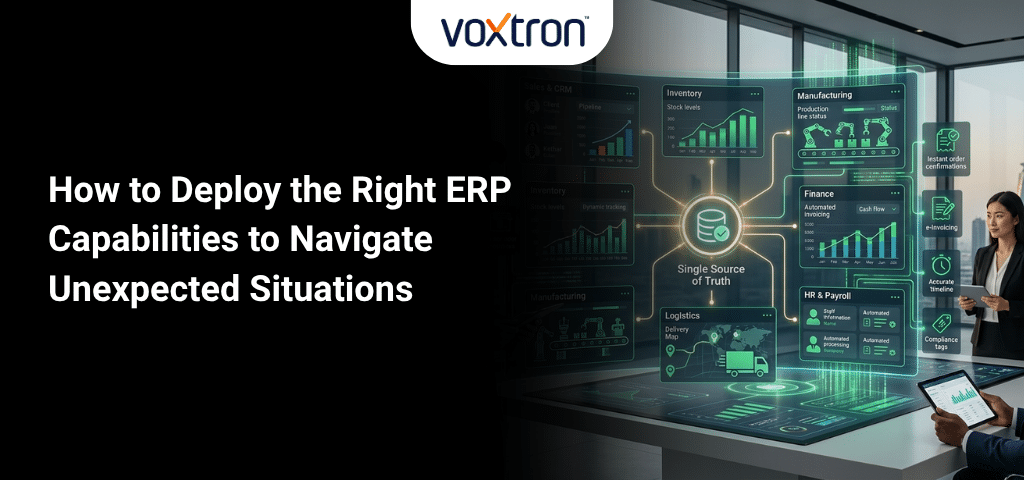
How to Deploy the Right ERP Capabilities to Navigate Unexpected Situations
Every business plans for growth, but few plan for disruption with the same rigour. Yet the last few years have made one thing clear: unexpected events are no longer rare. Supply chain shocks, sudden regulatory changes, currency volatility, geopolitical tensions, public health events, and rapid shifts in customer behaviour have all forced businesses to rethink how quickly they can adapt. The right ERP capabilities are central to that ability to adapt.
In each of these moments, one factor consistently separates organisations that recover quickly from those that struggle: the ability to see what is happening, decide what to do, and execute that decision across the business in days rather than months. That ability is largely shaped by which ERP capabilities a business has chosen to deploy.
A modern ERP is not just a record-keeping system. Configured well, it becomes the steering mechanism that helps leadership navigate situations no one planned for.
Why Most Businesses Struggle When the Unexpected Hits
When a disruption arrives, the typical scramble is familiar. Finance pulls reports from accounting software. Operations exports data from inventory tools. Sales digs through CRM and Excel sheets. Someone in IT stitches it all together in a presentation that is already outdated by the time it reaches the leadership table.
The issue is not a lack of effort or talent. It is that the underlying systems were built to record what happened, not to support fast, cross-functional decisions when conditions change. By the time the picture is clear, the window to respond has often closed.
Deploying the right ERP capabilities turns this around. Instead of reconstructing reality after the fact, leadership can read it live and act on it.
The ERP Capabilities That Matter Most in Uncertain Times
1. Real-Time, Cross-Functional Visibility
The first of the ERP capabilities to prioritise is unified, live data. When sales, inventory, procurement, finance, and HR sit on the same platform, leadership can see the impact of any disruption end-to-end: what stock is at risk, which orders are exposed, how cash flow is shifting, and which customers or suppliers need immediate attention.
Without this, every scenario discussion starts with “let me get back to you with the numbers”. With it, the conversation starts with “here is what we are seeing right now”.
2. Scenario Planning and Forecasting
Modern ERPs allow finance and operations teams to model scenarios quickly: a 20 percent drop in demand, a supplier going offline for six weeks, a sudden tariff change, or a currency swing. Instead of treating planning as an annual exercise, it becomes an ongoing capability that can be invoked the moment something changes.
This shifts the leadership conversation from “what will happen?” to “what should we do under each version of what might happen?”.
3. Flexible Workflows and Approval Paths
Rigid processes break under stress. When approval chains, payment terms, credit limits, or procurement rules need to change quickly — because the business has decided to extend support to key customers, tighten controls, or fast-track a new supplier — the ERP must allow these changes without a multi-week IT project.
Configurable workflows mean the business can tighten or loosen controls in line with risk, rather than being stuck with rules written for a different environment.
4. Strong Inventory and Supply Chain Modules
In any disruption, stock and supplier health is one of the first concerns. ERP capabilities such as multi-warehouse visibility, reorder rules, lead-time tracking, and alternate vendor management give procurement teams the tools to react before shelves empty or capital is locked into the wrong items.
Combined with sales forecasts from the same platform, this prevents the classic problem of overstocking what is no longer selling and running out of what is.
5. Integrated Customer and Service Data
In disruption, customer behaviour changes. Some segments spend more, others delay or cancel. An ERP integrated with CRM and contact-centre data lets the business see these shifts early and respond with targeted retention, payment flexibility, or upsell offers — rather than treating all customers identically.
6. Compliance and Audit Readiness
Unexpected situations often bring new regulatory or reporting demands: emergency tax measures, revised e-invoicing rules, additional disclosures. ERP capabilities that build compliance into transactions — rather than bolting it on at month-end — absorb these changes without paralysing operations.
Deploying ERP Capabilities the Right Way
Capability is not the same as configuration. Many businesses already own ERP licences that include most of the modules above, yet they have only deployed a fraction of what is available. The system records transactions, but the decision-support layer is never switched on.
Getting full value from your ERP capabilities requires three deliberate moves. First, identify which decisions the business is most likely to need to make under stress — cash, stock, customer, supplier, headcount — and ensure each has a live dashboard owned by a named leader. Second, configure exception alerts so the system flags problems early, instead of waiting for a human to notice. Third, run periodic “what-if” reviews using the ERP’s scenario tools, so the team is rehearsed when something real happens.
How Voxtron Helps Businesses Build Resilience into Their ERP
Voxtron works with businesses across the UAE and GCC to deploy Odoo ERP in a way that goes beyond go-live. Our implementation approach focuses on the decisions you actually need to make — not just the transactions you need to record. From dashboards and forecasting to inventory rules and integrated customer data, we configure the ERP capabilities that matter most when conditions are uncertain.
The businesses that come out ahead are not the ones that predicted the disruption. They are the ones whose systems let them see it sooner, decide faster, and execute together.
If you would like to assess how your current ERP capabilities stand up to the next unexpected event, reach out to our team for a focused review.