
How to Deploy the Right ERP Capabilities to Navigate Unexpected Situations
May 5, 2026
How to Protect Business Continuity and Customer Experience Using Modern CCaaS
May 5, 2026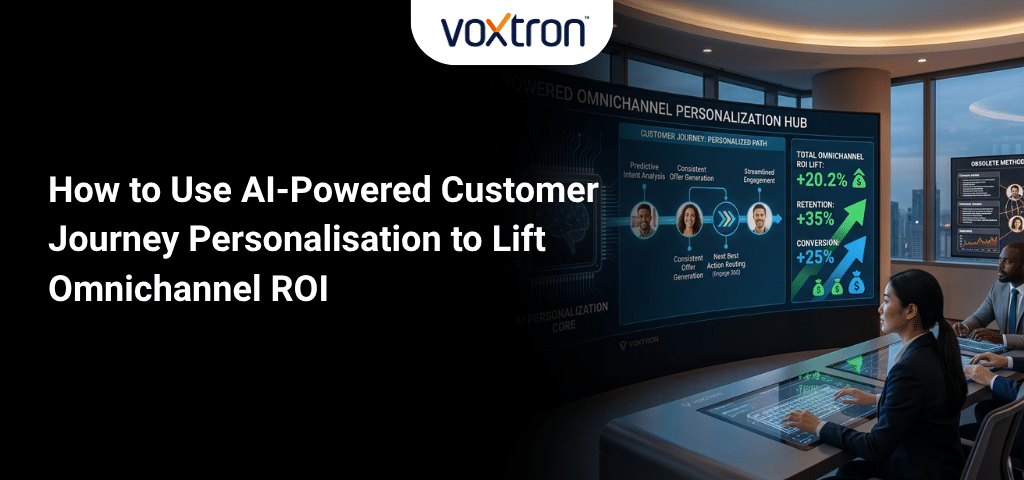
How to Use AI-Powered Customer Journey Personalisation to Lift Omnichannel ROI
Most businesses today already operate across multiple channels. Customers move between websites, apps, WhatsApp, email, voice, and social media within a single buying decision. The contact centre, marketing team, and sales team all interact with the same person, often without realising it. This is where AI-powered customer journey personalisation begins to matter.
The challenge is no longer reaching customers across channels. It is making each of those interactions feel connected, relevant, and timely — and doing it at a scale where manual personalisation is impossible. Artificial intelligence is what makes that scale practical.
Used correctly, AI does not replace the omnichannel strategy. It makes it commercially intelligent. The result is journeys that convert better, retain longer, and cost less per outcome — a direct lift in ROI rather than a vague improvement in “experience”.
Why Generic Omnichannel Falls Short
Many organisations equate omnichannel with simply being present on every channel. A customer messaging on WhatsApp, calling the contact centre, and visiting the website is treated as three separate interactions by three different teams using three different tools. The customer feels the disconnect immediately.
The cost is twofold. On one side, customers receive irrelevant offers, repeat themselves to multiple agents, and disengage from journeys that should have closed. On the other side, marketing and service spend continues to flow into broad campaigns and high-touch interactions that produce diminishing returns.
Personalisation closes this gap, but personalising hundreds of journeys manually is not realistic. AI-powered customer journey personalisation is the layer that makes it operational.
Where AI-Powered Customer Journey Personalisation Drives ROI
1. Building a Real, Unified View of the Customer
Before AI can personalise anything, the data has to come together. AI models work on the unified record of a customer — purchases, support history, channel preferences, sentiment, lifecycle stage, and value tier — sourced from CRM, ERP, and contact centre platforms.
Once that single view exists, AI can start to identify patterns that humans miss: which customers are about to churn, which are ready to upgrade, which respond to messaging versus voice, and which prefer self-service over agent-led support.
2. Predicting Intent and Next Best Action
AI does not just describe what customers have done. It predicts what they are likely to do next. For each journey, it can recommend the next best action: send a renewal reminder, offer a bundle, route to a senior agent, trigger a callback, or hold off entirely.
This is where ROI begins to lift. Marketing spend is concentrated on customers most likely to convert. Retention efforts are focused on the segments where save rates are highest. Contact centre time is reserved for conversations where a human genuinely adds value.
3. Personalising Content and Offers in Real Time
On the front end, AI tailors what each customer sees and hears. Product recommendations on the website, message copy on WhatsApp, the order in which options are presented in chat, and the offers a contact centre agent has on screen are all adjusted to the individual.
Crucially, this personalisation is consistent across channels. A customer who showed interest in a specific product on the website does not get a generic broadcast on WhatsApp the next day. The journey continues from where it left off.
4. Smarter Routing and AI-Assisted Conversations
In the contact centre, AI improves both routing and the conversation itself. Calls and chats are routed based on customer value, history, and intent — not just queue length. AI agents handle high-volume, repetitive queries end-to-end, while human agents are equipped with real-time suggestions, summaries, and sentiment indicators for the conversations that matter most.
Resolution times shorten, first-contact resolution improves, and human agents focus on complex, high-value interactions. The cost-to-serve drops while customer satisfaction rises.
5. Continuous Optimisation Through Feedback Loops
The final ROI lever is learning. Every campaign, every conversation, and every conversion (or non-conversion) becomes training data. AI models adjust over time, identifying what works for which segment on which channel — and what no longer does. Static personalisation rules age quickly. AI-powered customer journey personalisation gets sharper with every interaction.
A Practical Roadmap to Get Started
Personalisation at scale does not require a multi-year transformation programme. It does require a focused start.
Begin by unifying customer data across CRM, ERP, and contact centre platforms so AI has a clean foundation to learn from. Then identify two or three journeys where personalisation has the highest commercial impact — typically onboarding, retention of high-value accounts, and post-purchase upsell. Pilot AI-driven personalisation on these journeys, measure incremental revenue and cost savings against a control group, and only then expand to broader use cases.
This approach keeps the business focused on outcomes rather than on the technology itself, and it builds internal confidence in scaling the model further.
How Voxtron Enables AI-Powered Personalisation at Scale
Voxtron brings together the components that make AI-powered customer journey personalisation actually work in practice. The Voxvantage CCaaS platform unifies voice, chat, email, WhatsApp, and social into one intelligent workspace, while Engage 360 adds AI-powered chatbots, knowledge intelligence, and sentiment analysis. Combined with deep integration into CRM and ERP systems, they allow businesses to move from generic outreach to journeys that are personalised, measurable, and continuously improving.
The organisations seeing the strongest ROI today are not the ones using AI in isolated experiments. They are the ones embedding it into the journeys customers already travel — and letting it quietly raise the value of every interaction.
If you are ready to translate AI-powered customer journey personalisation into measurable revenue and retention, book a strategy session with Voxtron.