
Embedding Trust: How to Meet Human Expectations in AI-Led Customer Conversations
April 1, 2026
How to Deploy the Right ERP Capabilities to Navigate Unexpected Situations
May 5, 2026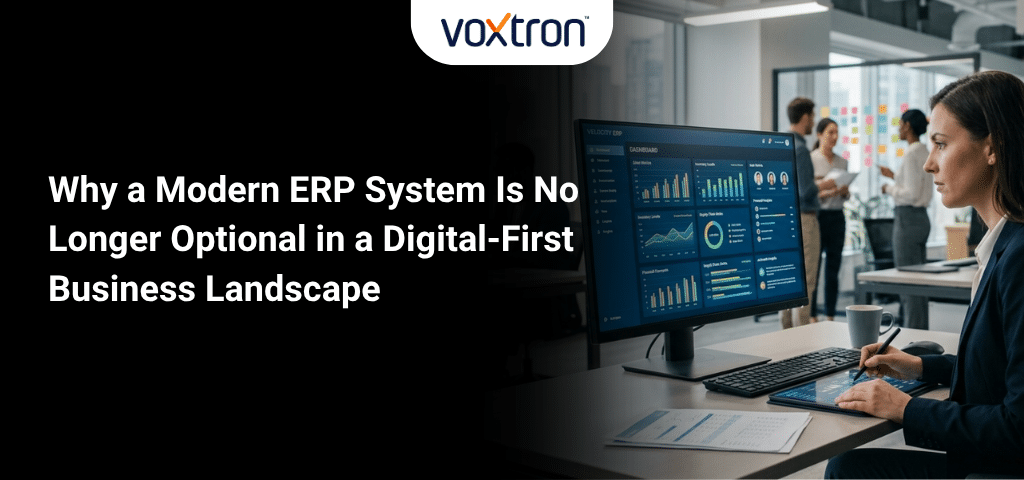
Why a Modern ERP System Is No Longer Optional in a Digital-First Business Landscape
A few years ago, a modern ERP system was something businesses considered once they reached a certain size. It was a multi-year project, a significant capital investment, and a decision usually pushed to the next financial year. That mindset no longer fits how digital-first businesses operate.
Today, customers expect instant order confirmations, real-time stock visibility, accurate delivery timelines, and seamless service across every channel. Suppliers expect digital invoicing, faster payment cycles, and automated reconciliations. Regulators expect audit trails, e-invoicing compliance, and VAT reporting at the click of a button. None of this is achievable on spreadsheets, disconnected accounting tools, or department-specific apps that do not speak to one another.
In a digital-first economy, a modern ERP system is no longer a back-office tool. It is the operating system on which the rest of the business runs.
The Cost of Operating Without a Modern ERP System
Many SMEs in the region still run on a patchwork of standalone applications: an accounting tool here, an inventory tracker there, separate CRMs for sales, and Excel sheets to bridge the gaps. On the surface, the business appears to function. Underneath, the cost is significant.
Sales teams quote prices without visibility into actual stock or production capacity. Finance teams close books a week late because data has to be reconciled manually across systems. Procurement reorders items that are already on the way because no one platform shows the true position. Customer service apologises for delays it had no way of foreseeing.
Each of these is a small inefficiency on its own. Combined, they translate into delayed cash flow, eroded margins, missed sales opportunities, and customers who quietly move to a competitor with a smoother experience. In a digital-first market, this gap widens every quarter.
What Digital-First Really Demands from a Business
Digital-first does not simply mean having a website or accepting online payments. It means the entire business is structured to respond to customer and market signals in real time. That requires three things working together.
First, a single source of truth. Sales, inventory, finance, HR, and customer service must all draw from the same live data. Decisions made on yesterday’s numbers are no longer competitive.
Second, automation of repetitive work. Tasks like invoice generation, stock replenishment, payroll, expense approvals, and tax filings should run with minimal manual touch. The team’s attention belongs on customers and growth, not on data entry.
Third, scalability without re-platforming. As the business adds branches, products, geographies, or sales channels, the system should extend rather than break. A modern ERP system is built to grow with the business, not to be replaced every few years.
Why Cloud-Ready ERP Platforms Are Different
The ERP of a decade ago was rigid, expensive, and slow to deploy. Modern, cloud-ready platforms such as Odoo have changed that equation. They are modular, which means a business can begin with the modules it needs most — say, accounting, inventory, and CRM — and add manufacturing, HR, e-commerce, or project management as it grows.
They are also far more affordable to deploy and operate than legacy ERPs. Cloud hosting, browser-based access, and modern integration capabilities have brought enterprise-grade capability within reach of mid-sized and even smaller businesses. For a growing organisation in the UAE or wider GCC, this lowers both the financial and operational barrier to going digital-first.
The Strategic Outcomes a Modern ERP System Delivers
1. Faster, Better-Informed Decisions
When leadership can see live dashboards on revenue, margin, receivables, inventory turn, and project profitability, decisions move from reactive to proactive. Conversations shift from “what happened last month?” to “what should we do next quarter?”.
2. Stronger Cash Flow and Working Capital
Automated invoicing, integrated payment links, and real-time receivables tracking shorten collection cycles. Better stock visibility reduces excess inventory and frees up working capital that was quietly tied up in slow-moving items.
3. A Customer Experience That Actually Holds Together
When the contact centre, sales team, and finance department all work from the same record, customers stop having to repeat themselves. Quotes are accurate, deliveries are predictable, and service issues are resolved without three follow-ups.
4. Compliance Without the Last-Minute Scramble
VAT, e-invoicing, corporate tax, and audit requirements are increasingly digital. A modern ERP system builds compliance into day-to-day transactions instead of leaving it as a quarter-end firefight.
From Optional Investment to Operational Necessity
The question facing most growing businesses today is no longer whether to implement a modern ERP system, but how quickly they can do it without disrupting operations. The longer the delay, the more workarounds, custom spreadsheets, and tribal knowledge accumulate — and the harder migration becomes later.
Choosing the right partner matters as much as choosing the right platform. A good implementation partner will not simply install software. They will map current processes, recommend where to standardise and where to customise, train teams, and stay engaged after go-live to make sure the system actually delivers the outcomes it was bought for.
Voxtron, as an experienced Odoo ERP partner in the Middle East, helps businesses make this transition with minimum disruption and maximum value. Our team works alongside yours to design, deploy, and support an ERP environment that fits how your business operates today and how you plan to grow tomorrow.
If your current systems are starting to slow you down, it may be time to take the next step. Talk to our team to explore how a modern ERP system can put your business on a digital-first footing.