From QuickBooks to Odoo: The SME Migration Playbook for GCC Businesses
June 18, 2026
Agent Burnout Is a CX Problem: How Modern CCaaS Tools Quietly Fix It
July 30, 2026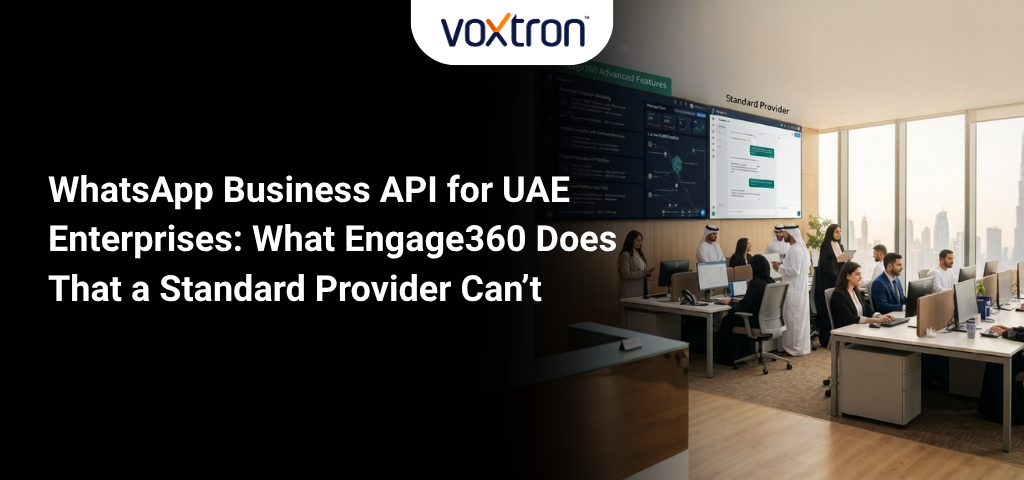
WhatsApp Business API for UAE Enterprises: What Engage360 Does That a Standard Provider Can’t
In the UAE, WhatsApp is not a channel. It is the channel. Customers expect to message a bank the same way they message a friend, expect a hospital to send appointment reminders through WhatsApp rather than SMS, and expect a retailer to confirm an order without making them open another app. Any enterprise still treating WhatsApp as a side experiment in 2026 has already fallen behind its customers.
The route to doing this properly is the WhatsApp Business API. That is the official enterprise version, designed for high-volume conversations, automation, and integration into existing customer systems. The question that trips up most organisations is not whether to adopt it, but how — and specifically, what kind of provider to use.
The Provider Landscape, Briefly
WhatsApp Business API is not sold directly by Meta to end-customers. It is delivered through Business Solution Providers (BSPs). On the surface, all BSPs look similar: they give the enterprise a verified number, send and receive messages through the API, and bill per conversation. Some have a basic dashboard. Some plug into a small set of CRMs. Most operate at the level of “use our portal to broadcast templates and reply manually.”
That model is fine for a small business sending order confirmations. It falls apart for an enterprise that wants WhatsApp to be a true engagement layer — connected to the CRM, integrated with the contact centre, automated where it should be automated, and handed off to live agents when it shouldn’t. That is the gap that Engage360 is built to close.
What Standard Providers Do Well
To be fair to the basic BSPs, they handle the core mechanics adequately. Number verification, template approval through Meta, message delivery, basic reporting. For a retailer that just wants to send abandoned-cart reminders, that may be enough.
Where they struggle is the moment WhatsApp stops being a broadcast channel and starts being a conversation. The customer replies to the reminder asking about delivery times. The standard BSP dashboard pings an alert, someone in the support team manually picks it up, opens a separate window to check the order in the CRM, copies a tracking number back, replies, and moves on. Multiply that by 5,000 conversations a day across a bank, hospital, or telecom operator, and the model breaks.
Where Engage360 Operates Differently
Engage360 starts from a different premise. It treats WhatsApp not as a standalone channel but as one of several engagement surfaces inside a unified customer interaction platform. The same agent workspace handles WhatsApp, web chat, email, social media, and SMS, with the customer’s full history visible regardless of which channel they walked in through.
That single design choice changes what is possible:
- Unified inbox across channels. An agent picks up a WhatsApp message and can see that the same customer emailed three days ago and chatted on the website yesterday. No more apologising for not having context.
- AI chatbot with seamless handoff. Routine queries get handled by the chatbot — balance enquiries, appointment booking, order status — and complex cases get passed to a live agent with the full chatbot conversation already in view. The customer never repeats themselves.
- CRM and ERP integration. When the chatbot confirms an order or the agent updates a ticket, that action flows back into the CRM and the contact centre record automatically. No copy-paste, no shadow data.
- Template management built for enterprise scale. Meta’s template approval process can be opaque. Engage360 manages submissions, tracks rejections with reasons, and helps craft compliant templates that get approved on the first or second attempt.
- Real-time analytics across the whole engagement. Not just “messages sent and delivered” but resolution time, deflection rate, escalation rate by topic, sentiment trends, and channel-mix evolution.
The Conversation That Sells It
The clearest way to understand the difference is to imagine a single customer journey. A patient at a private hospital in Dubai books an appointment on the hospital website. They get a WhatsApp confirmation. The day before, they get a reminder with a one-tap reschedule button. On the morning of the appointment, they message the WhatsApp number asking if they can come thirty minutes earlier.
With a basic BSP: the message lands in a generic inbox. An admin staff member sees it, opens the hospital’s scheduling system in another tab, checks availability, swaps the slot, types back manually. Average response time, fifteen minutes if they are quick.
With Engage360: the chatbot recognises the intent, checks live availability through the hospital’s integration, offers two earlier slots, the patient picks one, and the system rebooks instantly. The contact centre never needed to touch the conversation. Total time, under two minutes. If the patient had asked something complex — a medical question, a billing dispute — the chatbot hands off cleanly to a live agent who sees the entire conversation, the booking history, and the patient profile in one screen.
Why This Matters for UAE Enterprises Specifically
Two regional factors make this gap larger in the UAE than in many other markets. The first is the absolute dominance of WhatsApp in customer expectations — message volumes per customer are several times higher than in markets where SMS or email still dominate. The second is the language and channel mix. UAE customers move fluidly between English and Arabic, between WhatsApp and web chat, between voice and message. A platform that handles one channel well but cannot stitch the rest together creates exactly the disjointed experience customers complain about.
Engage360 is designed for that environment. Multilingual handling, Arabic-first design where needed, seamless integration with Voxvantage cloud contact centre, and the option to deploy with UAE data residency. Standard global BSPs were not built with that combination in mind, and it shows.
The Practical Test
Any enterprise evaluating a WhatsApp solution can apply a simple stress test: pretend a customer sends a message at peak time. Map every step from message arrival to resolution. Count the system switches, the manual lookups, the copy-paste actions. If that map has more than two or three nodes, the provider is not doing enough. WhatsApp is fast for the customer. It should be fast for the agent too.
Want to see how WhatsApp could actually work for your operation? Request an Engage360 demo and we’ll walk through a real conversation flow built around your business — or get in touch with our team to discuss WhatsApp Business API and unified engagement for your enterprise.