
WhatsApp Business API for UAE Enterprises: What Engage360 Does That a Standard Provider Can’t
June 18, 2026
The Hidden Cost of Disconnected Channels: What Your CSAT Score Isn’t Telling You
July 30, 2026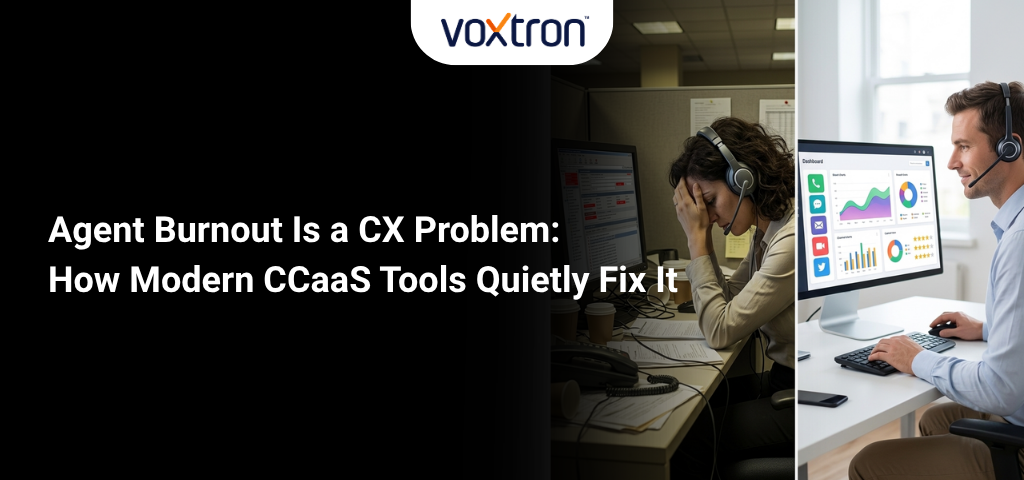
Agent Burnout Is a CX Problem: How Modern CCaaS Tools Quietly Fix It
Agent burnout in contact centers is often treated as an HR issue, but it’s really a customer experience problem. When agents struggle with outdated systems, multiple applications, and constant pressure, customers experience slower resolutions, lower service quality, and inconsistent interactions. Modern CCaaS platforms help remove these daily frustrations while improving both agent productivity and customer satisfaction.
The connection is straightforward, but it gets missed because the two teams report to different leaders. Agent experience and customer experience are the same problem, viewed from opposite sides. Fix one and the other improves almost automatically. Ignore one and the other will not move no matter how many CX consultants get hired.
What Actually Burns Agents Out
It is not the volume of calls. Agents who feel in control can handle high volumes for years. What grinds them down is friction. Six logins to start a shift. A customer history screen that takes twelve seconds to load. Three separate tools for voice, chat, and email, each with its own quirks. Knowledge articles that are out of date. A supervisor metric that punishes long calls even when the issue genuinely takes time to resolve. Endless transfers because the right team is in a different system.
Every one of those small frictions is invisible to leadership but exhausting to the agent. The agent absorbs it, smiles through it, gets through the shift — and the customer feels the residue. A burnt-out agent does not deliver good service even when they are trying their hardest, because the cognitive load of fighting the tools eats the energy that should be going into the conversation.
The Quiet Improvements Modern CCaaS Brings
Modern cloud contact centres do not solve burnout with motivational posters. They solve it by stripping out the friction one piece at a time. None of these features sounds revolutionary in isolation, but the cumulative effect on agent experience — and therefore on customer experience — is substantial.
A Single Agent Workspace
When voice, chat, WhatsApp, email, and social all land in one interface, the agent stops switching tabs. Voxvantage brings every channel into a unified workspace alongside the customer’s history, the relevant CRM record, and the active case. The agent answers from one screen, regardless of channel. The mental tax of context-switching, which research consistently identifies as one of the largest drains on knowledge-worker performance, just disappears.
AI Assistance That Actually Helps
There is a useful version of AI in contact centres and a useless one. The useless version replaces the agent badly and frustrates the customer. The useful version sits behind the agent and removes drudgery. Auto-generated wrap-up notes after a call. Real-time suggested responses pulled from the knowledge base. Sentiment indicators that warn an agent when tone is shifting. Translation in chat so an agent can serve an Arabic-speaking customer fluently even if they are weaker in Arabic.
Each of those features saves seconds per interaction. Over a shift, those seconds become minutes. Over a month, those minutes become hours that the agent gets back for the conversations that genuinely need human attention.
Smart Routing That Respects the Agent
Old-school routing pushes whichever call arrives next to whichever agent is free. That model is efficient on paper and brutal in practice. The agent who just finished a tough complaint gets the next tough complaint. The agent best suited to handle a billing query gets a technical query because they happened to be available.
Skills-based routing in modern CCaaS platforms looks at agent capability, recent workload, complexity of upcoming items, and even mood signals to distribute work in a way that matches strength to need. The customer gets a better-suited agent. The agent gets work they can actually do well. Both sides win without anyone noticing the routing rules underneath.
Quality Feedback That Coaches, Not Polices
Old quality assurance picked five random calls a month, scored them against a checklist, and delivered the result to the agent like a school report card. New quality programmes — especially when supported by AI-driven call analytics — sample far more, surface specific moments worth discussing, and frame feedback as coaching rather than judgement.
The agent stops feeling watched and starts feeling supported. The supervisor spends less time scoring and more time developing the team. The customer eventually hears the difference in tone and confidence.
Flexibility in Where and How Agents Work
The shift to cloud-delivered contact centres also enables hybrid working at scale. Agents who can work some days from home report sharply lower burnout, and contact centres with proper remote infrastructure consistently retain staff longer. This is not a perk debate — it is a workforce planning reality. Younger agents in the UAE labour market increasingly factor flexibility into job decisions, and contact centres that cannot offer it lose to those that can.
How This Shows Up in the Numbers
Organisations that have invested seriously in agent experience through modern CCaaS platforms report a recognisable pattern within twelve months:
- Agent attrition drops by 20 to 40 percent, removing one of the largest hidden costs in contact centre operations.
- First Call Resolution rises, because experienced agents stay long enough to actually become experienced.
- CSAT lifts even without any direct change to scripts or training, because the tone of conversations improves.
- Supervisors spend less time recruiting and more time coaching, which compounds the previous three effects.
The Strategic Shift
The organisations getting this right have stopped treating agent experience and customer experience as separate budgets. They evaluate platform investments by what they do for both sides at once. They include agent feedback in CX dashboards. They measure the time-to-first-screen-load alongside the time-to-resolution. They ask the contact centre team what slows them down, and they fix it.
It is not glamorous work. Nobody puts “reduced login friction” in an annual report. But the customers feel it, the numbers move, and the people doing the actual work of customer service stay long enough to get good at it. That is the quiet CX win modern CCaaS makes possible — and most leaders still underestimate.
Want to see how a unified agent workspace changes the day-to-day? Speak with the Voxtron team about Voxvantage, AI agent assistance, and unified channel design, or request a demo built around your contact centre setup.