
Multi-Entity, Multi-Currency, Multi-Headache? How Odoo Handles GCC Group Companies
July 30, 2026
Contact Centres for UAE Insurance: Claims, Renewals, and Customer Retention
September 1, 2026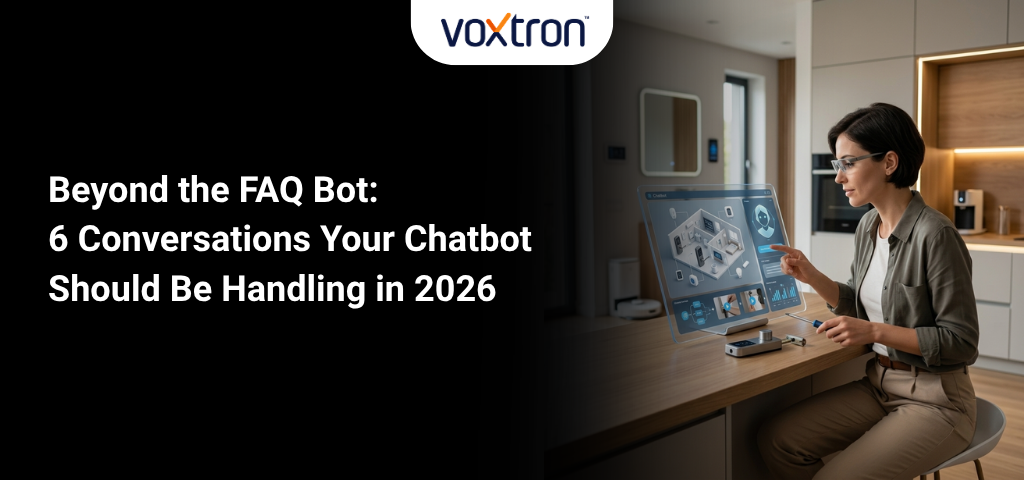
Beyond the FAQ Bot: 6 Conversations Your Chatbot Should Be Handling in 2026
The chatbot market has been around long enough that most enterprises have one. Most of them are doing the same thing: answering questions about opening hours, branch locations, and basic product details. Useful work, but barely scratching what a modern chatbot is now capable of. In 2026, the gap between a basic FAQ bot and a properly deployed AI engagement bot is not incremental. It is the difference between deflecting 15 percent of contacts and deflecting 60 percent — between a tool that saves a few agent minutes and a tool that fundamentally changes how the operation runs.
If a chatbot is still living in FAQ land, here are six conversations it should already be handling. These are not future possibilities. They are live deployments running today across UAE banks, healthcare providers, retailers, and government entities.
1. Booking, Rebooking, and Cancelling Appointments
Appointment-driven businesses — clinics, salons, service centres, government entities, professional services — lose enormous time to phone-based scheduling. A patient calls to book a follow-up. The receptionist checks availability, offers slots, books it, sends a confirmation. Five to seven minutes per call, multiplied by hundreds of calls a day.
A properly integrated chatbot does the same job in under ninety seconds. It checks live availability against the practitioner’s calendar, offers the next three viable slots, confirms the booking, and pushes the appointment into the scheduling system. The customer never waits on hold. The receptionist is freed for the conversations that genuinely need a human.
2. Order Status, Tracking, and Delivery Updates
Order status is the most common reason a customer reaches out to a retailer or distributor. “Where is my order?” alone accounts for 25 to 40 percent of inbound support volume in e-commerce-heavy operations. A bot connected to the order management system, the warehouse, and the courier API can answer this instantly — with live tracking data, expected delivery window, and one-tap options to reschedule or change the address.
More importantly, this conversation is the gateway to proactive engagement. The same bot that answers reactively can send a WhatsApp message the moment the order ships, a follow-up when it is out for delivery, and a feedback prompt after delivery completes. The customer never had to ask.
3. Payment Status and Light-Touch Collections
Collections teams in the UAE spend large portions of their day on simple reminder calls. “Your invoice is overdue, would you like to settle today?” A chatbot can handle the first one or two cycles of these conversations entirely. It sends the reminder, accepts a payment commitment, generates a payment link, confirms when the payment lands, and escalates only when the customer does not respond or asks for a longer plan.
Done well, this approach lifts on-time collections without hiring more agents and without creating the friction that aggressive collections calls can cause. Customers tend to respond better to a polite WhatsApp reminder than to an unexpected phone call.
4. Onboarding and KYC-Light Flows
New customer onboarding has historically meant forms, branch visits, and document submissions. A chatbot can now handle the entire low-risk portion of onboarding inside a conversation — collecting basic details, verifying contact information, capturing initial preferences, even guiding the customer through document upload with image recognition for ID validation.
For higher-risk processes that need full KYC, the bot does not replace the regulated workflow. It runs the preparation. By the time the customer reaches the compliance team, every standard field is already filled in, every required document is already uploaded, and the human review time is cut by half or more.
5. Service Recovery and Complaint Triage
Most complaints share the same underlying pattern: the customer is unhappy about something specific, wants to be heard, and wants the resolution path to be clear. A chatbot is not the right tool to resolve a serious complaint — that is human work. But it is excellent at the first ninety seconds of triage.
The bot acknowledges receipt, classifies the complaint, captures structured details (what happened, when, with whom, what outcome is expected), and routes the case to the right team with all of that context already attached. The customer feels heard immediately. The agent receives a complete case file instead of a one-line message. Resolution time drops, and the tone of the eventual conversation is calmer because the customer has already vented productively.
6. Cross-Sell and Personalised Recommendations
This is where chatbots quietly turn into revenue generators. When a bot has access to the CRM, the order history, and the product catalogue, it can do something a human agent cannot do at scale: offer the right product to the right customer at the right moment. The customer who just booked a hotel gets offered an airport transfer. The customer who just bought a printer gets reminded about ink subscriptions. The banking customer who just received a salary credit gets a personalised fixed-deposit suggestion.
Done badly, this is spam. Done well — with the bot only offering relevant suggestions in moments where the customer is already engaged — it lifts attach rates without harming experience. The numbers favour the patient operators. Conversion on contextual chatbot recommendations consistently outperforms email and display advertising by a wide margin.
Why Most Chatbots Don’t Do These Things
The technology to do all six exists today and has for some time. What stops most chatbots from delivering is not the bot itself — it is the lack of integration with the surrounding systems. A bot disconnected from the CRM cannot personalise. Disconnected from the order management system, it cannot answer status questions. Disconnected from the contact centre, it cannot hand off cleanly when a human is needed.
This is the design principle behind Engage360. The chatbot does not live on its own. It is part of a unified engagement platform that includes WhatsApp, web chat, social, email, and seamless handoff to Voxvantage for voice and complex resolution. It integrates with the CRM, the ERP, and the scheduling systems that the rest of the business already runs. That integration is what turns a chatbot from a deflection tool into an engagement engine.
The Practical Starting Point
An enterprise looking at its current chatbot can ask one diagnostic question: when the bot needs information that lives in another system — order status, account balance, appointment availability — does it fetch it live, or does it apologise and pass the customer to a human? If the answer is the second one, the bot is doing 15 percent of its potential job. Closing that gap is usually the highest-ROI move in the entire CX stack.
Curious what your chatbot could actually be doing? Request an Engage360 demo and we’ll show real conversation flows built around your business, or get in touch to discuss integrating AI chatbots with your existing CRM and contact centre.