
Odoo HR and Payroll in the UAE: Meeting Labour Law and WPS Requirements
September 1, 2026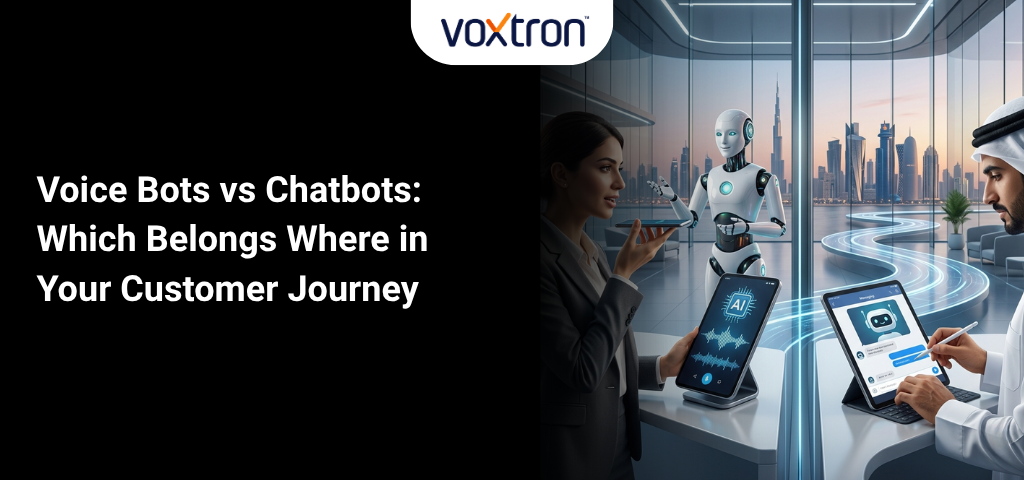
Voice Bots vs Chatbots: Which Belongs Where in Your Customer Journey
Conversational AI has moved from a single technology into a family of related capabilities. Chatbots handle text-based conversations across web, WhatsApp, and messaging channels. Voice bots handle spoken conversations on inbound and outbound calls. Both use similar underlying AI models, but they operate in very different customer contexts and serve different purposes in a well-designed engagement strategy.
For UAE enterprises building or expanding their conversational AI capability, the practical question is rarely which technology is better in absolute terms. It is which technology belongs where. This article looks at the strengths of each, the situations where they are most valuable, and how they work together as complementary parts of a connected customer journey rather than as competing alternatives.
What Chatbots Do Well
Chatbots are the more mature and widely adopted of the two technologies, and they perform particularly well in specific situations. They handle asynchronous conversations well, allowing customers to pause and return without losing the thread. They work naturally with structured choices, which makes them well-suited to booking, ordering, and form completion. They can present visual elements including images, catalogues, buttons, and links, which extends their usefulness into scenarios that pure text cannot handle.
Their reach is amplified significantly through the WhatsApp Business Platform, which allows enterprises to deploy chatbots directly into the messaging channel most UAE customers already use daily. This eliminates the friction of downloading an app or visiting a website, and it puts the chatbot in the customer’s pocket alongside conversations with family and friends. Chatbots are also easier to design, iterate, and deploy than voice bots. The feedback loop from launch to improvement is shorter, and the cost of correcting a wrong response is lower, which makes them a natural starting point for organisations building conversational AI capability for the first time.
What Voice Bots Do Well
Voice bots have their own distinct strengths, particularly in situations where speech is the natural communication channel. They handle inbound calls where the customer is already reaching out by phone, avoiding the friction of redirecting the conversation to another channel. They work well in urgent situations where speed of resolution matters more than the depth of interaction. They serve customers whose hands are busy — driving, cooking, working — and who cannot easily type. They connect with older or less digitally comfortable customer segments who remain more comfortable with voice as a primary channel. They support conversations that benefit from voice biometric authentication, which can significantly reduce the friction of security questions in banking, insurance, and government service contexts.
Voice bots also carry a different emotional feel from chatbots. A conversational voice interaction, done well, can feel more personal and more considered than a text exchange, and it can build trust in situations that benefit from the human quality of speech even when the speaker is not actually human.
Where They Overlap
Some use cases can be served effectively by either technology, and the choice depends on customer preference and channel behaviour rather than any inherent superiority of one approach. Appointment booking and rescheduling can work through both. Balance and status enquiries suit either format. Payment reminders and confirmations, order tracking, and frequently asked service questions all fall into this overlapping zone. In these areas, the right answer is often “both” rather than “one or the other.” Customers who prefer messaging use the chatbot, customers who prefer to call use the voice bot, and the underlying knowledge and business logic serves both interactions equally.
Where One Is Clearly Better
Not every use case is a coin toss. Some situations point clearly to one channel over the other, and understanding these clear cases helps organisations focus their conversational AI investment where it delivers the most value. Chatbots are clearly the better fit when the interaction is visual, silent, or reference-heavy:
- Product browsing with images and interactive catalogues
- Complex form completion where the customer benefits from seeing what they entered
- Situations requiring document upload
- Multi-language interactions where the customer switches between English and Arabic mid-conversation
- Silent environments such as offices, meetings, and public spaces
Voice bots are clearly better when the interaction is urgent, hands-free, or speech-native:
- Emergency triage where hands-free operation matters
- Interactions with customers on the move
- Authentication-heavy interactions where voice biometrics reduce friction
- Older customer segments with lower digital comfort
- Outbound proactive outreach where a call feels more considered than a text notification
The Connected View: Journeys, Not Channels
The most effective conversational AI deployments treat chatbots and voice bots as complementary parts of a wider customer journey, not as competing channels or as parallel investments. A single customer might start with a chatbot on the website to compare products, receive a WhatsApp reminder about a follow-up appointment, call to change that appointment while driving — handled by a voice bot — receive a chatbot survey after the visit, and return to the WhatsApp channel weeks later to book something else.
Across all of these steps, the customer expects consistency. The voice bot should know about the chatbot conversation, and the chatbot should know about the call. Without that continuity, each interaction feels like a fresh start, and the customer loses trust in the brand’s ability to coordinate itself. Continuity is what turns multiple channels into a single relationship, and it is often more important to the customer than the specific capabilities of any individual channel.
What the Technology Needs to Support
Delivering this connected view depends on several capabilities working together behind the scenes. A unified customer record needs to be shared across chatbot, voice bot, and live agent channels, so that everyone — human or AI — is working from the same picture of the customer. A consistent knowledge base needs to underlie both voice and text conversations, so that customers receive the same answer regardless of channel. Shared authentication state means customers do not have to re-verify their identity at every step. Common intent recognition keeps conversation classification consistent across channels, and handover paths from each bot to live agents need to preserve full context, so that escalation feels like continuation rather than restart.
These capabilities are not exotic, but they do require the underlying platforms to be genuinely integrated rather than merely coexisting. This is often where standalone conversational AI deployments fall short and where integrated engagement platforms deliver their strongest value.
How Voxtron Supports Both
Engage360 provides the digital and chatbot engagement layer across WhatsApp, web chat, social media, and email, with AI-driven conversation handling that supports both English and Arabic. Voxvantage provides the contact centre layer where voice bots operate alongside live agents on inbound and outbound voice channels. The two platforms share customer context, knowledge sources, and reporting, allowing UAE enterprises to deploy voice and text conversational AI as part of a single connected customer engagement platform rather than as two separate technology investments that require constant reconciliation.
Conclusion: The Right Bot for the Right Moment
The choice between voice bots and chatbots is not binary and rarely needs to be. Each technology has situations where it is clearly the right choice, many use cases where both should be available and the customer should decide, and journeys where the two work together seamlessly to deliver an experience that neither could deliver alone. The organisations getting the most value from conversational AI are those that design for the customer journey rather than for individual channels, and that treat voice and text as connected surfaces of the same underlying engagement capability.
To explore how Engage360 and Voxvantage can deliver connected voice and chatbot experiences for your customers, speak with our team today or request a demo.