
Agent Burnout Is a CX Problem: How Modern CCaaS Tools Quietly Fix It
July 30, 2026
Multi-Entity, Multi-Currency, Multi-Headache? How Odoo Handles GCC Group Companies
July 30, 2026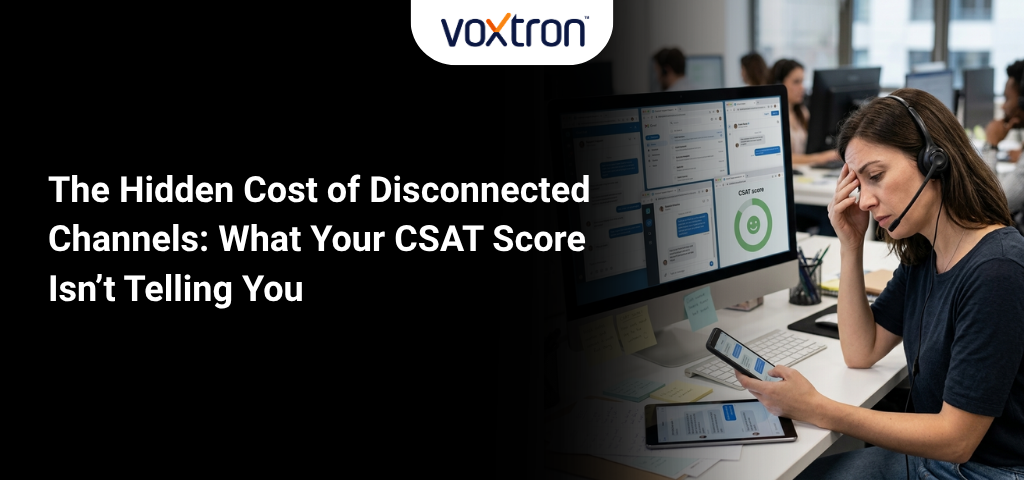
The Hidden Cost of Disconnected Channels: What Your CSAT Score Isn’t Telling You
A CSAT score of 4.4 out of 5 looks healthy on a board pack. The chart is green, the trend is gently upward, the customer experience team gets a nod, and the meeting moves on. But CSAT is a survey of customers who stayed. It does not interview the customers who quietly stopped engaging. And it does not capture the friction inside the journeys that did get answered. The most valuable CX insight an organisation rarely sees is the cost of disconnected channels — and that cost almost never shows up in the headline survey number.
What Disconnected Channels Actually Look Like
Most enterprises in the UAE now offer four to six customer channels: phone, email, WhatsApp, web chat, social media, sometimes a mobile app. The channels exist. The investment was made. The customer can technically reach the brand any way they like.
The disconnection happens behind the scenes. The voice team runs on one platform. WhatsApp is handled by a marketing-led BSP. Email comes through a shared inbox managed by the support team. Web chat runs on whichever widget the website team chose two years ago. Social media is handled by a different team again, often in a separate office. Each one logs into its own tool, sees its own slice of customer history, and works in isolation.
From the outside, the brand looks like it has done multichannel. From the customer’s perspective, every channel is a different company. Repeat the problem each time. Re-verify identity each time. Get told a different answer by a different team. Hang up, send a WhatsApp, get a third answer, give up.
The Costs CSAT Doesn’t Measure
CSAT is usually triggered after a closed interaction. It measures the experience of the person who completed a contact. It does not capture the costs that accumulate around the interaction or before it ever started. Those costs are real, and they are heavier than most organisations realise.
Repeated Effort by the Customer
When channels are disconnected, the customer becomes the messenger. They explain the issue to chat, then re-explain to voice, then re-explain to the WhatsApp team. Industry research consistently identifies repeated effort as the single largest driver of churn intent — larger than wait times, larger than failed resolutions. The customer who is reaching out for the third time about the same issue is not measuring how nice the agent was. They are deciding whether to leave.
Duplicate Work by the Agents
On the operational side, disconnected channels create duplicate handling. Two agents pick up the same issue from two channels and work it independently, occasionally producing conflicting answers. Tickets get opened twice. Resolution paths diverge. The contact centre supervisor cannot see across channels, so the duplication is invisible until someone runs a manual reconciliation. The hidden cost of this is usually 8 to 15 percent of total agent capacity — capacity that could be eliminating new hires.
Lost Cross-Channel Context
A customer messages on WhatsApp to ask about an outstanding invoice. The next day they call the contact centre about an unrelated service issue. With connected channels, the voice agent sees that the customer also has an active billing query and can mention it proactively. With disconnected channels, the two issues remain strangers, and the opportunity for a complete resolution is lost. The customer leaves feeling that the brand does not know them — which, structurally, it does not.
Failed First-Contact Resolution
When the agent only sees the current channel’s data, first-call resolution drops. The agent transfers the customer to another team, schedules a callback, or asks them to email the right department. Each handoff is a moment where the customer might just walk away. Disconnected channels are one of the largest unrecognised drivers of low FCR, and the impact compounds across every contact volume.
Inconsistent Brand Voice
WhatsApp replies sound casual because the team that handles them is marketing-led. Email replies sound formal because the team that handles them is part of operations. Voice agents follow yet another tone guide. The customer hears three different brands depending on how they reach out. None of this is anyone’s fault — it is structurally inevitable when channels are owned by different teams with different tools — but it erodes trust in subtle ways that surveys rarely capture.
What Unified Engagement Actually Solves
The technical solution is conceptually simple: bring every channel into one system, with one customer record, one history, one queue, and one set of agents able to operate across all of them. The execution is harder, because it requires both a unified contact centre and a unified digital engagement layer that work together rather than as two separate platforms.
Voxtron approaches this through two connected products. Voxvantage provides the contact centre core — voice, routing, agent desktop, quality, analytics. Engage360 provides the digital engagement layer — WhatsApp, web chat, social, email, AI chatbots. The two share a common customer record, so an agent picking up a voice call sees the full WhatsApp history from yesterday, and a chatbot responding to a web visitor knows about the open ticket in voice.
When this works, three things change that show up in numbers very quickly. Repeat contact rate drops, often by 20 to 30 percent within the first quarter. Average handle time goes down because the agent does not need to chase context. And CSAT — the metric that was already looking healthy — starts moving in a way it had refused to move before, because the friction it never measured is finally being removed.
Questions Worth Asking Internally
Before investing more in any single channel, a few internal questions reveal whether disconnection is hiding inside a healthy-looking score:
- Can any agent, in any channel, see the customer’s last five interactions across all other channels — or only their own?
- When a customer escalates from WhatsApp to voice, do they have to repeat the issue?
- Who owns the WhatsApp number — and is that the same team that owns voice?
- Does the leadership team see one CX dashboard or four?
- What is the repeat contact rate across channels, and how is it trending?
If any of those answers are uncomfortable, the CSAT score is hiding a cost. And the customers who already walked away are not around to take the survey.
Curious what unified channels would change for your operation? Talk to Voxtron about connecting voice and digital engagement into one customer view, or explore our full CX solutions across the UAE and GCC.