
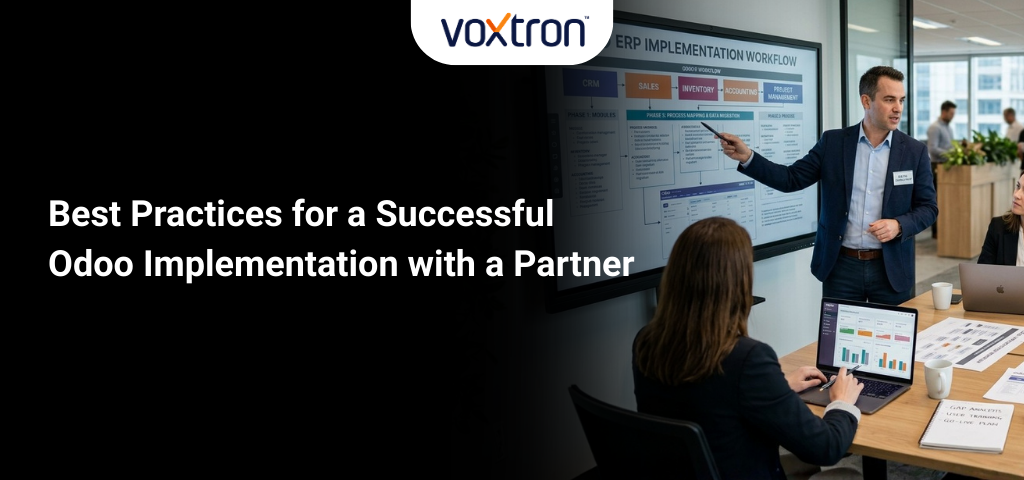
Best Practices for a Successful Odoo Implementation with a Partner
Sustainable ERP success depends more on your internal administrative readiness than on technical execution alone. Based on our experience delivering custom and off-the-shelf Odoo ERP rollouts for SMEs across manufacturing, retail, logistics, distribution, and services industries, one insight consistently emerges:
When administrative foundations are strong, technical challenges dissolve, timelines reduce, and ROI multiplies.
This article provides five actionable practices for leadership teams to build a powerful administrative Odoo implementation blueprint. When implemented alongside your Odoo partner, these practices can reduce deployment time by 30–50%, minimize customization, and future-proof your operations.
- Prioritize Administrative Clarity Over Technical Fixes
More than code glitches, ERP projects falter due to unclear requirements. Businesses grasp their workflows intuitively, but rarely document them crisply. This vagueness fuels scope creep as the business and technical team later disagrees on “must-haves” versus “nice-to-haves.”
To prevent this, we recommend starting with a cross-functional workshop. Gather sales, production, warehouse, finance, and HR leads. Next, capture every process detail, without prescribing solutions. Aim for concrete details with numerical data instead of vague terms. For instance, the expectation should be documented as, “Handle 500 daily orders at 99% accuracy using barcode scanning and real-time stock alerts,” instead of “improve efficiency.”
Checklist for Requirements Doc:
- Process flows with inputs/outputs
- Pain points and KPIs
- Edge cases
Use this information to prepare a comprehensive requirements document to share with your Odoo partner. Such a blueprint will clearly expose gaps early and enable your partner to map the business workflows to standard modules more efficiently.
- Appoint an Internal Command Center
Miscommunication is another persistent cause of ERP implementation delays. To mitigate this risk, it is essential to designate a dedicated internal resource who serves as the central coordination and decision authority throughout the project lifecycle.
This individual should possess
- Business fluency across functions.
- Strong communication skills.
- Basic Odoo navigation skills.
Before formal implementation begins, onboard this resource through structured Odoo sandbox demonstrations and detailed partner walkthroughs. Doing so will ensure functional familiarity and contextual understanding. Additionally, empower them with direct access to the leadership team, a clearly defined escalation framework, and a dedicated project communication channel. It will enable rapid issue resolution and uninterrupted information flow.
The scope of this role must be clearly defined and rigorously enforced. Core responsibilities should include daily triaging of partner queries, consolidation of cross-functional inputs, weekly executive status reporting, and resolution of operational blockers within 24 hours. This approach eliminates fragmented communication, prevents delays caused by departmental hand-offs, and ensures execution velocity.
- Co-Create your Odoo implementation Roadmap by aligning with Your Partner
Once you select your Odoo implementation partner, the engagement must immediately transition into structured, high-intensity collaboration. Begin by presenting your complete requirements document in the first deep-dive planning session.
Drive clarity by asking precise, outcome-oriented questions, such as:
Which native modules, applications, or configurations will deliver this with minimal customization?
All discussions, decisions, and delivery commitments should be captured in a shared execution matrix and maintained in real time. This matrix should ensure full transparency, accountability, and governance.
Formalize delivery timelines through contractually defined milestones, supported by service-level commitments.
This disciplined approach significantly reduces the total cost of ownership (TCO) over the system lifecycle. Additionally, conduct quarterly roadmap reviews to continuously align evolving business needs with Odoo’s expanding functional capabilities and ensure sustained platform relevance.
- Champion Minimal Customization for Long-Term Agility
Excessive customization is a major cause of ERP failure. It complicates upgrades, increases maintenance effort by up to three times, and creates long-term vendor dependency.
To ensure scalability and resilience, consider a configuration-first strategy.
Odoo’s modular architecture enables up to 90% of business requirements to be addressed through standard configurations, native modules, marketplace applications, and Odoo Studio. A good implementation partner would demonstrate these configurable alternatives upfront. They would cover workflows, reporting, and automation before proposing any custom development.
In any case, customization must be strictly limited to non-negotiable business or regulatory gaps and capped at 5–10% of total scope.
This disciplined approach ensures smoother upgrades, sustained agility, and a higher long-term return on ERP investment.
- Cultivate Unwavering Commitment
ERP implementations are not short-term projects. Hence, you should expect process realignments, training challenges, and stabilization issues post go-live.
Nearly 70% of ERP delays and cost overruns result from internal de-prioritization. This happens when the leadership focus shifts toward day-to-day operational pressures. Sustained executive commitment is therefore a critical success factor.
To counter this risk, establish weekly milestone check-ins using focused 15-minute stand-ups. Support it with structured team huddles for progress alignment and decision closure. Furthermore, formalize accountability by explicitly linking ERP success to measurable business KPIs such as faster order-to-cash cycles, inventory reduction, and improved reporting accuracy.
To strengthen adoption, implement structured change management through department-level pilots and phased rollouts, complemented by short, role-based training sessions to minimize cognitive overload. Reinforce momentum by celebrating micro-wins, such as successful module deployments or workflow automations, which builds morale and sustains engagement. Maintain a centralized risk and dependency log, assigning clear ownership, escalation paths, and resolution timelines to ensure execution discipline.
Conclusion
Strong administrative foundations are essential for a successful Odoo ERP implementation. These must be built on five critical pillars:
- Clear and structured requirement definition,
- Centralized internal ownership,
- Disciplined collaboration with your Odoo partner,
- A configuration-first customization strategy, and
- Sustained leadership commitment.
Each of these elements helps to reduce complexity, improve alignment, accelerate timelines, and maximize long-term return on investment.
Nonetheless, the role of an experienced Odoo implementation partner cannot be overstated.
A seasoned partner brings proven methodologies, industry insights, and the practical expertise needed to anticipate challenges, navigate bottlenecks, and accelerate decision-making by the business. This ensures a smoother ERP rollout, faster adoption, and predictable ROI.
By combining your internal administrative blueprint with the right partner, you transform ERP implementation from a complex IT project into a strategic business enabler.
At Voxtron, we have successfully guided organizations across industries through high-impact Odoo implementations. Our proven delivery frameworks and customer success stories demonstrate how businesses can achieve faster deployments, lower risk, and long-term agility.
Contact our team today to explore our success stories and make an informed decision for your Odoo journey.
