

Best Practices for a Successful Odoo Implementation with a Partner
March 23, 2026
Embedding Trust: How to Meet Human Expectations in AI-Led Customer Conversations
April 1, 2026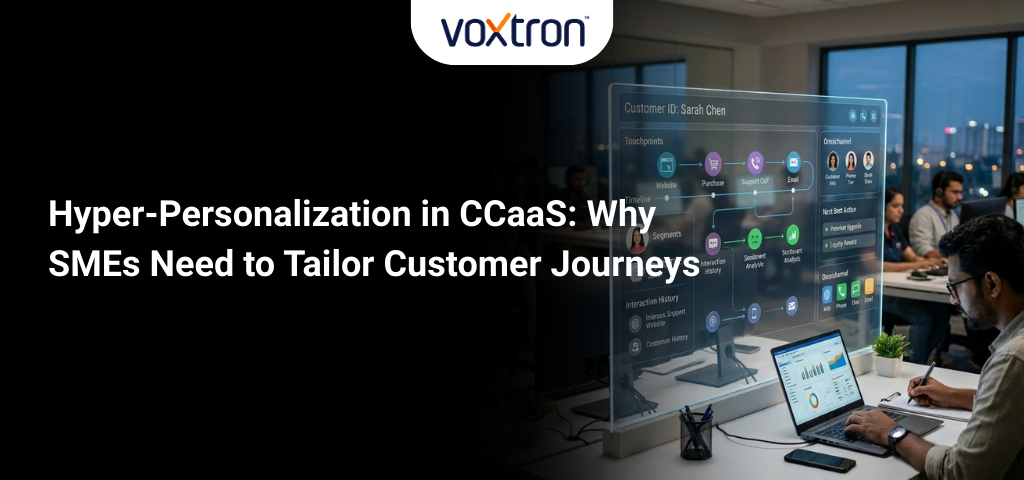
Hyper-Personalization in CCaaS: Why SMEs Need to Tailor Customer Journeys
Customers no longer compare their service experience with that provided by your competitors. Instead, they compare it with the best experience they’ve had anywhere. A personalised email from a bank, a contextual reminder from an e-commerce app, or a support agent who resolves their problem in the shortest time has set a new benchmark.
This is why hyper-personalization in CCaaS is relevant. Hyper-personalization uses real-time customer data, context, and behaviour to shape every interaction as it happens. For SMEs, this means delivering relevant, connected, and meaningful customer journeys.
For example, a long-standing client calls a logistics firm about a delayed shipment. Instead of starting from scratch, the agent immediately gains the full context from previous emails, recent support tickets, delivery preferences, and the urgency associated with similar past requests.
With this insight, the agent arranges priority handling of this shipment for the customer at no additional cost. The issue is resolved faster and the interaction strengthens customer trust.
This is hyper-personalization in action. For enterprises evaluating solutions, it’s key to relevance and ROI.
What Is Hyper-Personalization in CCaaS?
Basic personalization in customer service appears at a surface level. An interaction may start with the agent using the customer’s name, viewing basic account details, or referring to past purchases. Although helpful, this information is applied in a fixed way and rarely adapts as the conversation unfolds.
However, hyper-personalization in a CCaaS environment brings together:
- Real-time interaction data
- Historical customer context
- Channel-specific behaviour
- Intent and urgency signals
This combined context allows each interaction to adapt dynamically. Routing decisions, agent responses, self-service options, and follow-ups are not based on a predefined script. Instead, the customer needs at that time define the direction of the interaction.
Why SMEs Need Hyper-Personalized Customer Journeys
Modern customers expect fast, consistent, and context-aware responses across channels. However, most businesses have small teams managing these rising interaction volumes under tight service-level expectations.
Hence, it leads to generic interactions, longer resolution times, and avoidable escalations. Eventually, it leads to dissatisfied customers.
Hyper-personalized customer journeys directly address these pressures by:
- Reducing repetitive conversations
- Shortening resolution times
- Minimising escalations
- Improving first-contact resolution
When customers feel recognised and supported, they are more likely to stay loyal. For SMEs, this translates into repeat business, referrals, and lower service costs. These outcomes have an immediate impact on growth and profitability.
Modern CCaaS platforms like Voxvantage make this level of personalization achievable, without enterprise budgets or complex IT dependencies.
How CCaaS Has Evolved to Enable Tailored Customer Journeys
Early cloud-based contact centre solutions focused mainly on replacing traditional office phone systems with cloud-based calling. While this reduced infrastructure overhead, customer interactions were still handled in silos, with little visibility across channels.
Modern CCaaS platforms have since evolved into fully integrated customer engagement systems. They now combine CRM data, analytics, and omnichannel capabilities to maintain persistent customer context throughout the journey. This evolution enables SMEs to support tailored customer experiences in several practical ways:
- Persistent customer context across channels
Customer data, interaction history, and preferences follow the customer across voice, chat, email, and messaging. This eliminates the need to repeat information. - Frictionless channel switching
Customers can move between channels without losing context, whether they start with self-service, shift to chat, or escalate to a live agent. - Real-time behavioural adjustments
Routing decisions, agent prompts, and self-service flows adapt dynamically based on intent, urgency, and interaction history, rather than relying on fixed scripts. - Predictive customer–agent matching
Skill-based and data-driven routing connects customers to the most suitable agent from the start, reducing transfers and speeding up resolution.
Key CCaaS Capabilities That Enable Hyper-Personalization
The following capabilities form the foundation for personalised journeys that scale with the business.
Unified customer profiles
A single, real-time view of the customer ensures agents and automated systems work from the same context, regardless of channel.
Context-aware routing
Here, interactions are routed based on intent, urgency, and history for faster and more relevant responses.
Adaptive self-service
Self-service options improve over time by learning from previous interactions, reducing effort for both customers and agents.
Journey-level analytics
Instead of analysing isolated interactions, SMEs gain visibility into the full customer journey, helping identify friction points and opportunities for improvement.
What Features Should You Look for in CCaaS for Hyper-Personalization?
Not every CCaaS platform supports hyper-personalization effectively. The focus should be on capabilities that bring customer context together, adapt interactions in real time, and provide visibility across the journey.
Robust CRM sync for comprehensive customer profiles
Ensures a unified, real-time view of customer history, preferences, and interactions across all channels.
Sentiment-based dynamic routing
Routes interactions based on intent, urgency, and conversation signals, not just agent availability.
Evolving self-service bots
Enables self-service that improves over time while allowing seamless escalation to live agents.
Advanced journey analytics
Provides visibility into end-to-end customer journeys to identify friction points and optimisation opportunities.
Why Is Hyper-Personalization Critical for SME success?
Generic customer journeys place a heavy burden on small teams and stretch service capacity.
Hyper-personalization improves efficiency by ensuring each interaction starts with the right context and follows the most relevant path. When routing, self-service, and agent responses adapt to customer intent and history in real time, issues are resolved faster and more accurately.
Customer experience research shows that reducing customer effort has a direct impact on retention. For SMEs, even incremental efficiency gains translate into meaningful cost savings, better resource utilisation, and more consistent service quality as the business grows.
Conclusion: How Voxvantage Enables Hyper-Personalization for SMEs
Hyper-personalization in CCaaS is not about adding more tools or processes. It is about removing friction from the customer journey and ensuring every interaction feels relevant and connected.
Voxvantage is designed to help SMEs deliver hyper-personalized customer journeys without unnecessary complexity. By unifying customer context across channels and enabling journeys that adapt in real time, Voxvantage helps SMEs resolve issues faster, reduce repeat interactions, and build stronger, more trusted customer relationships.
Moreover, as customer expectations continue to rise, Voxvantage enables SMEs to deliver experiences that scale with their business, without losing relevance, efficiency, or control.
To learn more about how Voxvantage can help you hyper-personalize customer interactions and design smarter customer journeys, speak with our team today.